

Luxury Arabian Oud Perfume Blog: Your Guide to Exquisite Fragrances
Is Perfume an Appropriate Corporate Gift in the UK?
Yes, in most cases. Perfume is an appropriate corporate gift in the UK when it goes to a team or an existing client, stays inside the recipient’s gift policy limit (commonly £50 for a single gift), and is chosen as a presented set rather than a personal signature scent. It becomes a problem when it is sent to win new business, offered during a live tender, given to a public sector worker, or picked out for one individual colleague.
That is the short version. The longer version matters, because the risk with a perfume gift in the UK has very little to do with fragrance and almost everything to do with two things: the recipient’s own gift policy, and how personal the gift feels.
Here is how to get both right.
Why this question comes up at all
Perfume is a strong corporate gift on paper. It looks considered, it arrives presented, it does not sit in a drawer like a branded mug, and the UK is a country that genuinely enjoys fragrance. Walk through any office in London on a Monday and you will smell it.
So why the hesitation?
Two reasons. First, UK companies have tightened their gift rules considerably, and a lot of people have been told to declare anything they receive. Second, fragrance is worn on the body. That makes it read as more intimate than a hamper, and people are cautious about that at work.
Both problems are solvable. You just have to solve them on purpose.
What UK gift policies actually say
This is the part most gifting guides skip, and it is the part that decides whether your gift lands well or creates paperwork for someone.
Most UK organisations set a value limit, and it is lower than people expect. As a published example, the Single Source Regulations Office gifts and hospitality policy sets a limit of “£50 for any one gift” and flags anything where the “cumulative value from any one organisation or individual exceeds £200 in any 12 month period”. Every gift accepted or declined goes on a register that is published on their website.
That is one public body, not a national rule. But the shape is typical. Private companies often use similar figures, and many run a gifts and hospitality register too.
The practical takeaways:
- Assume a £50 single-gift limit unless you know otherwise. It is the most common threshold you will meet.
- Assume the gift will be written down. Somebody may have to declare it by name and value.
- Remember the cumulative total. If you already sent something in June, a December gift adds to the same annual figure.
Transparency International’s anti-bribery guidance on gifts and hospitality sets out a useful test. A gift should be given for a genuine reason, create no sense of obligation, be proportionate to the occasion, be recorded openly, be infrequent, and fit the recipient’s own code of conduct. If your gift passes all six, you are on firm ground.
The last one is the one people forget. Their policy governs, not yours.
The Bribery Act, in plain English
The Bribery Act 2010 is why gift rules got stricter, and it is worth understanding because it is widely misread.
The Act does not ban corporate gifts or hospitality. The Ministry of Justice guidance treats genuine hospitality that builds relationships as a normal part of doing business. What creates an offence is intent: providing an advantage in order to induce someone to perform their role improperly.
The Serious Fraud Office has indicated it looks at a handful of practical factors, including whether the company had a clear gifts policy, whether the spend sat inside it, whether the cost was proportionate to the recipient, whether it was recorded, and whether the timing lined up with a business decision. Timing in a competitive situation is the one that gets flagged.
Translate that into giving decisions and you get three simple rules.
Do not send a gift to win a first meeting. A gift attached to a request reads as a trade, not a gesture. It is also the fastest way to have your email deleted.
Do not send anything while a tender or contract negotiation is live. Wait until it is decided, whichever way it goes.
Do not gift public sector staff without checking first. Many are required to refuse or declare almost everything. A well-meant bottle can create a genuine problem for them.
Christmas gifts to clients you already work with are a different situation entirely. That is established practice, and it is where perfume sits most comfortably.
The part nobody says out loud: perfume feels personal
Here is the honest risk, and it has nothing to do with law.
Fragrance is worn on skin. That puts it in the same emotional bracket as jewellery for a lot of people. Gift it to a team and it reads as generous. Gift it to one colleague, one to one, and it can read as something else.
The risk goes up when there is a seniority gap, when the gift is given privately rather than in front of others, and when nothing explains why the person is receiving it.
UK employers are also more alert to workplace conduct than they were a few years ago. The Worker Protection (Amendment of Equality Act 2010) Act 2023 introduced a duty on employers to take reasonable steps to prevent sexual harassment, in force from 26 October 2024. Nothing in it mentions gifts. But it explains why HR teams now think carefully about anything that could look like personal attention between colleagues, and why your gift should leave no room for interpretation.
None of this means avoiding fragrance. It means give it the right way.
Six fixes that make a perfume gift completely safe
These are small changes and they remove nearly all of the awkwardness.
1. Give to the group, not to an individual. One gift per person across a whole team is recognition. One gift to one person is a gesture that needs explaining.
2. Choose unisex over gendered. A shared, unisex profile takes gender out of the decision entirely. It also means you can order the same thing for everyone.
3. Send a set, not a signature scent. Picking someone’s personal fragrance is a guess with a low success rate. A set of two or three gives them a choice, which is a completely different message.
4. Let the packaging do the work. A gift that arrives in its own presentation box looks intentional. A loose bottle looks like something you had spare.
5. Write one clear line. “From all of us at [company], thank you for a brilliant year.” That single sentence removes any ambiguity about why the gift exists.
6. Include an alcohol-free option where you can. Not everyone wears alcohol-based fragrance, for religious, cultural or personal reasons. Oil-based attar solves this quietly, without anyone having to ask.
What to actually choose
Here is how our perfume gifts range maps onto the situations above. There are 92 options in the category, but these six cover most corporate gifting jobs.
Staying under a £50 gift policy limit
Three single bottles, each £39.99, each 100ml Extrait de Parfum, each unisex. The value sits comfortably under the common £50 threshold, and because the three are completely different in character you can vary them across a team without anyone getting the same thing as the person beside them.
- Sabbia is the rich one. Turkish rose and saffron on top, agarwood and patchouli in the heart, amber, labdanum and vanilla underneath. Choose this for someone who likes a warm, opulent scent.
- Fouco is the clean one. Lemon zest, bergamot and mint over lavender and geranium, finishing on sandalwood, cedar and tonka bean. This is the safest blind choice of the three, because crisp and fresh suits almost everyone and works in an office.
- Vague sits between them. Sicilian bergamot and pink pepper up front, agarwood and white amber in the middle, leather, vetiver and musk at the base. Bright at first, grounded after an hour.
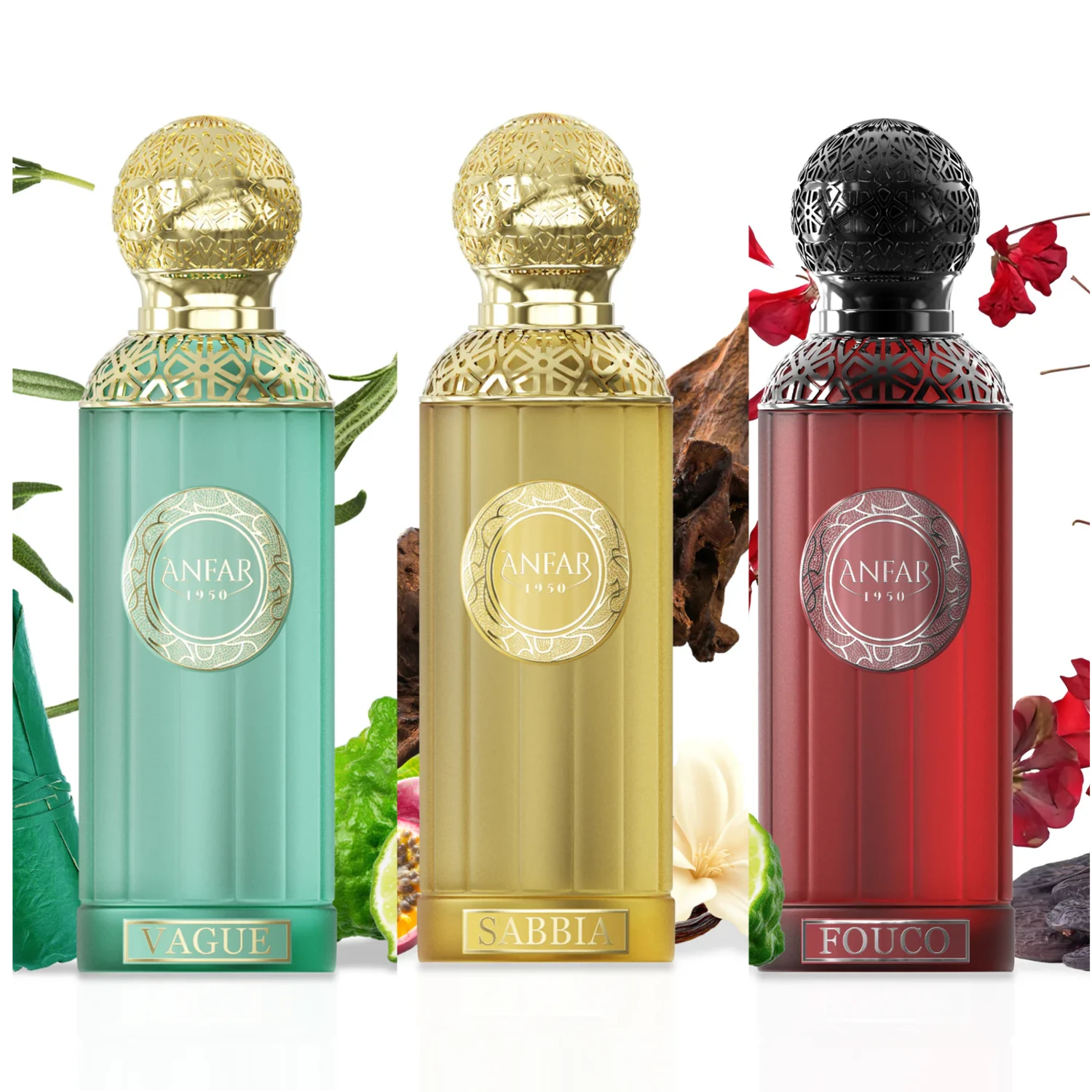
All three are from Anfar’s Element Edition and all three carry 8 to 12 hours of longevity, so the gift does not disappear by lunchtime.
The strongest all-round corporate choice
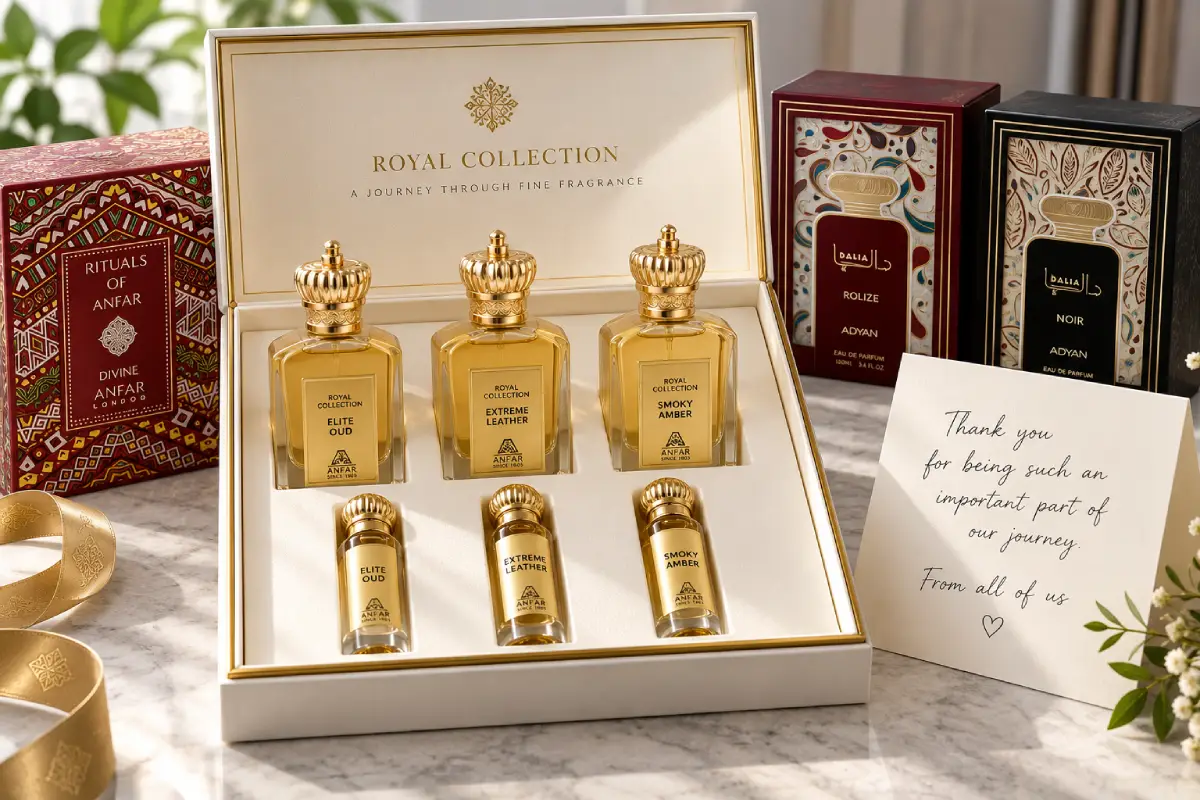
The Royal Collection Oud Perfume Gift Set at £79.99 is the one we would put forward first for client gifting. It contains three 50ml Eau de Parfum bottles, Smokey Amber, Extreme Leather and Elite Oud, plus three 6ml alcohol-free concentrated oud oils, all in a presentation box.
Three reasons it works so well here. It arrives gift-ready, so no wrapping is needed. Six fragrances means the recipient chooses rather than being told what to wear. And the three oils are alcohol-free and wudu-friendly, which makes this a single gift you can send confidently to a mixed team without knowing anyone’s preferences.
A step up for a team or a long-standing client
The Adyan Dalia Series set at £64.99 gives three 100ml Eau de Parfum bottles: Dalia Rouge, warm and spicy, Dalia Ciel, clean and refreshing, and Dalia Noir, rich and intense. Adyan has been making fragrance since 1950, and the set is unisex, so it reads well for anyone.
When policy allows something more substantial
The Rituals of Anfar Collection at £139.99 is a trio of 80ml Extrait de Parfum: Meditation, Divine and Chef-D’Oeuvre, built on pink pepper, tuberose, amber and musk.
Be straight with yourself about this one. At £139.99 it sits above the single-gift limit most gift registers use, and above the £200 annual cumulative figure faster than you would think. It is the right gift for a founder-to-founder relationship, a partner of many years, or a team milestone where you know the policy allows it. It is the wrong gift to post to a new contact.
What HMRC allows, briefly
This is worth two minutes of your time, because the tax treatment of a staff gift and a client gift is not the same.
Gifts to your own staff. HMRC’s trivial benefits exemption, set out in EIM21864, can make a small gift tax free if all the conditions are met. The cost of providing the benefit must not exceed £50, it cannot be cash or a cash voucher, it cannot be a contractual entitlement, and it cannot be given in recognition of particular services performed. Where the employer is a close company and the recipient is a director, the exemption is capped at £300 in the tax year.
Note that the test is the cost of providing the benefit, so include delivery and any wrapping in your figure, not just the ticket price. A £39.99 bottle leaves some headroom. A £64.99 set does not.
Gifts to clients. This is where people get caught out. Under BIM45070, a gift to a customer is only an allowable deduction if it carries a conspicuous advertisement for your business, on the gift itself and not on the wrapping, costs no more than £50 per recipient per tax period, and is not food, drink, tobacco or a voucher.
In practice that rules out branded perfume, because nobody wants your logo printed on a bottle they keep on a dressing table. So treat a client fragrance gift as a relationship cost, not a deductible expense.
Neither of these makes perfume a bad gift. They just mean you should know which budget it comes out of. Check the detail with your accountant before you commit, since your own circumstances change the answer.
Quick checklist before you order
Run through these five and you are done.
- Do you know the recipient’s gift policy limit, or can you stay under £50 to be safe?
- Is there a live tender, pitch or contract negotiation? If yes, wait.
- Is the recipient a public sector employee? If yes, ask before sending.
- Is this going to a group, or to one individual? If one individual, is there a clear, stated reason?
- Does the gift arrive presented, with a line explaining who it is from?
If all five are clear, perfume is a genuinely good corporate gift. Browse the full perfume gifts collection to choose, and get in touch if you need several of the same set.
Frequently asked questions
Is perfume an appropriate corporate gift in the UK?
Yes, for existing clients and your own team, when it stays inside the recipient’s gift policy limit and arrives as a presented set. Avoid it for new prospects and during live tenders.
Is it OK to give perfume to a coworker?
It is fine as part of a team gift or a group present. Giving it to one colleague privately can read as personal, so give it openly and say who it is from.
How much should a corporate gift cost in the UK?
Many UK gift policies set a limit around £50 for a single gift, with an annual cumulative limit often near £200 per organisation. Staying under £50 is the safest default.
Can I give perfume to a client during a tender?
No. Timing a gift alongside a business decision, especially a competitive one, is exactly the situation anti-bribery guidance warns about. Wait until the decision is made.
Which perfume is safest to gift when you do not know their taste?
A unisex gift set. It removes the gender question and gives the recipient a choice instead of a single scent you picked for them.
Are corporate perfume gifts tax deductible in the UK?
Gifts to clients are generally not deductible unless they carry conspicuous advertising and cost under £50. Small staff gifts may qualify under HMRC’s trivial benefits exemption. Confirm with your accountant.