Luxury Arabian Oud Perfume Blog: Your Guide to Exquisite Fragrances
Explaining top, middle and base notes in perfume

TL;DR:
- Top, middle, and base notes are classified by their molecular weight and evaporation time, shaping a fragrance’s evolution. Patience and skin testing are essential, as the true scent character emerges during the dry-down, often beyond initial impressions. Layer carefully from heavy to light, limiting to two or three fragrances, to create harmonious and personal scent experiences.
Top, middle, and base notes are the three structural layers of any perfume, defined by their molecular weight, volatility, and the order in which they reveal themselves on skin. Understanding this note hierarchy is the difference between buying a fragrance that disappoints after twenty minutes and discovering one that becomes genuinely yours over hours. The fragrance note hierarchy shapes every olfactory decision you make, from the first spray to the final dry-down. Whether you are exploring Arabian oud, layering musk with amber, or simply trying to make more confident purchases, explaining top, middle and base notes is where that knowledge begins.
What distinguishes top, middle and base notes chemically and temporally?
Fragrance notes are classified by molecular volatility and weight, which determines how quickly each layer evaporates from your skin. This is not a stylistic convention invented by marketers. It is chemistry.
| Note type | Molecular weight | Evaporation time | Typical examples |
|---|---|---|---|
| Top notes | 130–180 g/mol | 15–30 minutes | Citrus, bergamot, light herbs |
| Middle notes | 150–210 g/mol | 2–4 hours | Rose, jasmine, cardamom, spice |
| Base notes | 200–300 g/mol | 6–12+ hours | Oud, sandalwood, musk, amber, vanilla |
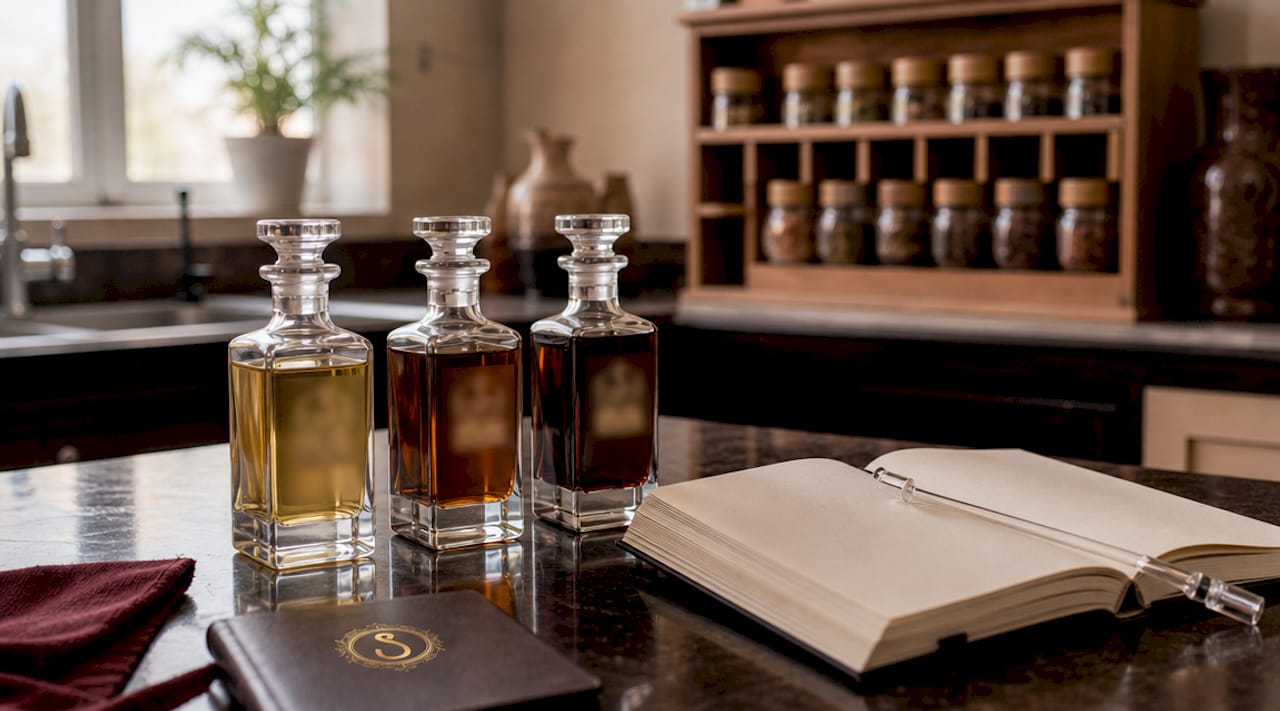
Top notes are the lightest molecules in the formula. They evaporate fastest, which is precisely why they make such a vivid first impression but rarely represent the full character of a scent. Middle notes, sometimes called heart notes, carry the emotional core of the fragrance. They are heavier, slower to lift, and responsible for what most perfumers consider the true identity of a composition. Base notes are the densest molecules of all, and they are what lingers on your skin, your clothing, and in the memory of anyone who encounters you.
The molecular weight ranges do overlap between top and middle notes, which matters. A molecule sitting at 160 g/mol might behave as a top note in one formula and a heart note in another, depending on concentration and the surrounding ingredients. This is why the fragrance pyramid is a useful guide rather than a rigid law.
Pro Tip: When testing a new fragrance, spray it on your wrist and check it at three intervals: immediately, at thirty minutes, and at two hours. Each check reveals a different layer of the composition and gives you a far more accurate picture than a single sniff.
How do top, middle and base notes interact in a fragrance’s lifecycle?
The scent pyramid is the standard model for understanding how notes in perfumes succeed one another, but the reality is more fluid and more interesting than a simple three-stage sequence. Notes overlap significantly, and some base molecules are detectable early in a fragrance’s development, while certain top notes linger longer than the industry standard suggests.
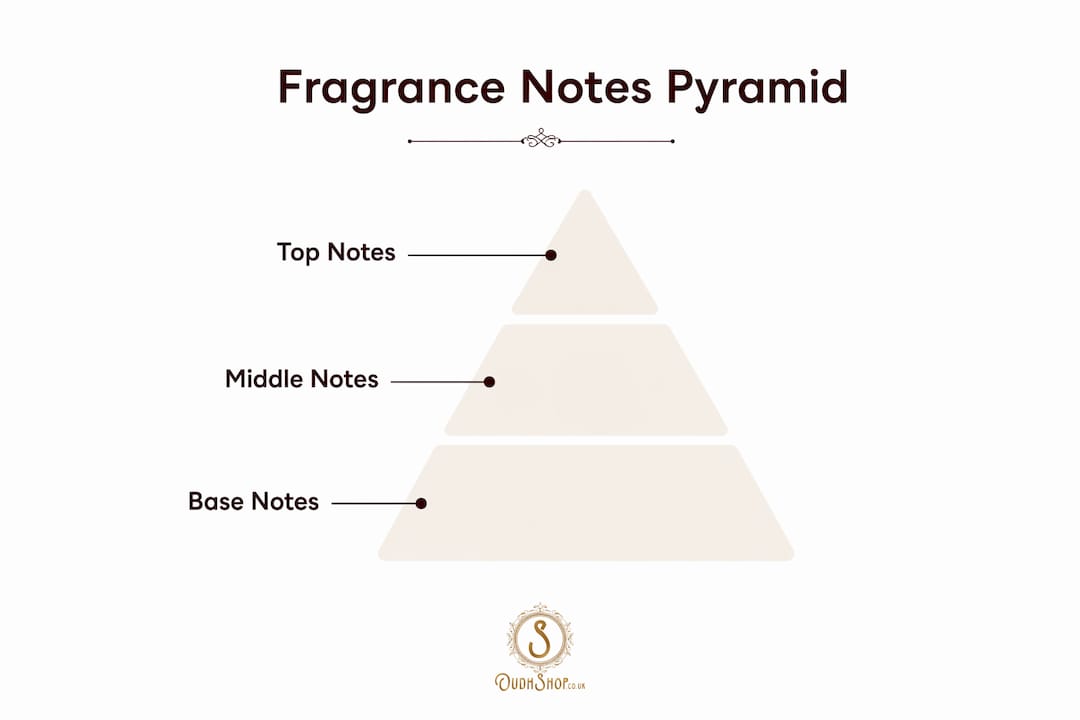
Think of it as a chord rather than a melody. At the moment of application, you hear all three notes simultaneously, but the top notes are loudest. As the lightest molecules lift away, the heart notes grow more prominent. By the time the base notes dominate, you are experiencing the fragrance at its most intimate and personal.
Skin chemistry plays a decisive role in this evolution. Temperature, hydration, and natural skin oils all influence how quickly notes evaporate and how they express themselves. A warm, well-moisturised skin tends to amplify base notes and extend their projection, while dry skin can cause top notes to vanish almost immediately. This is why testing on skin is non-negotiable for accurate evaluation.
“The fragrance pyramid is partly a marketing construct. Real perfume identity emerges in the middle and base, not just the top notes.” — Perfume Cultures
The emotional arc of a fragrance matters as much as its technical structure. Top notes create anticipation and first impressions. Middle notes, which commonly include florals such as rose and jasmine, spices like cardamom and saffron, and green or herbal accords, carry the emotional weight of the composition. Base notes provide the following:
- Longevity: Woods, resins, and musks that anchor the scent for hours
- Depth: Agarwood (oud), patchouli, and vetiver that add complexity and gravitas
- Memory: The olfactory signature that lingers on skin and clothing long after the top notes have vanished
- Warmth: Amber, vanilla, and benzoin that soften and round the overall composition
Understanding middle notes definition and base note behaviour transforms how you experience perfume. You stop judging a fragrance on its opening and start appreciating it as a living, evolving composition.
What are the best practices for layering fragrances?
Fragrance layering techniques are built on the same logic as the note hierarchy. You layer from the heaviest to the lightest, allowing each foundation to settle before adding the next element. Effective layering starts with the richest, woodiest base scent and builds upward, which is exactly how a perfumer constructs a formula from scratch.
Perfumer Gustavo Romero describes layering as a personal, creative exercise rather than a rigid formula, encouraging experimentation and patience with your own skin chemistry. That said, there are clear principles that prevent the most common mistakes.
Follow these steps for a harmonious layered result:
- Choose your base anchor. Select a fragrance with strong base notes, such as an oud attar, a sandalwood Extrait de Parfum, or a deep musk. This is your foundation.
- Apply the base first. Spray or dab it onto pulse points and allow it to settle for ten to fifteen seconds before adding anything else.
- Layer your heart note fragrance. Apply a middle-note-forward scent, such as a rose or jasmine-centred eau de parfum, over the base. The two should complement rather than compete.
- Add top note accents sparingly. A light citrus or herbal fragrance applied last will bloom over the foundation without overwhelming it.
- Wait fifteen to thirty minutes. Testing on skin for at least this long is the only reliable way to judge whether the combination works.
- Adjust ratios. If one scent dominates, reduce its application. A 1:1 ratio is a sensible starting point, but your skin chemistry will guide the final balance.
Pro Tip: Limit your layers to two or three fragrances maximum. Overcrowding the olfactory experience dulls the key notes and risks creating a chaotic, unreadable scent rather than a harmonious one.
The most common pitfall in layering is relying on top notes alone to judge compatibility. Two fragrances that smell wonderful together in their opening minutes may clash dramatically once the heart and base notes emerge. Always evaluate the combination at the thirty-minute mark before committing to wearing it out.
Complementary pairings that consistently work well include oud with rose (a classic Middle Eastern accord), sandalwood with vanilla, amber with spiced cardamom, and musk with white florals. These combinations succeed because their base and middle notes share similar molecular families, which means they blend rather than battle.
How can note knowledge guide smarter perfume purchasing?
The single most expensive mistake in fragrance purchasing is judging a scent within the first five minutes. Top notes evaporate within 15–30 minutes, and the heart and base define the lasting impression. Buying based on the opening alone is the olfactory equivalent of judging a book by its cover.
Practical guidance for making better purchases:
- Wait 30–60 minutes before deciding. The dry-down reveals the true character of a fragrance, including the base notes that will accompany you for the rest of the day.
- Identify your preferred base notes. If you consistently love fragrances with oud, sandalwood, or amber at their core, prioritise those when reading fragrance descriptions. Base notes provide longevity and depth that define the scent’s lasting impression.
- Test on skin, not paper. Blotter strips reveal top notes only. Your skin chemistry transforms the entire composition, particularly the middle and base layers.
- Consider perfume concentration. An Extrait de Parfum or Eau de Parfum carries a higher concentration of base note molecules than an Eau de Toilette, which means the perfume concentration directly affects how prominently the deeper layers express themselves and for how long.
- Use discovery sets and testers. Sampling before committing to a full bottle is the most rational approach to fragrance investment, particularly for complex compositions built around expensive base materials like Agarwood.
Understanding middle notes definition and recognising base note families also improves your ability to predict how a fragrance will wear on your specific skin. Someone with naturally warm, oily skin will find that base notes amplify and project beautifully. Someone with drier skin may need to moisturise before application to achieve the same depth and sillage.
The art of scent layering becomes genuinely creative once you understand which note families complement each other. Rather than wearing a single fragrance as prescribed, you can construct something entirely personal by combining a rich oud base with a lighter floral heart, creating a signature accord that no single bottle could replicate.
Key takeaways
A perfume’s true character lives in its middle and base notes, not its opening, making patience and skin testing the most valuable tools any fragrance enthusiast can develop.
| Point | Details |
|---|---|
| Note classification is chemical | Top, middle, and base notes differ in molecular weight and evaporation time, not just scent character. |
| Top notes mislead buyers | They evaporate within 15–30 minutes; the dry-down at 30–60 minutes reveals the real fragrance. |
| Layer from heavy to light | Apply base note fragrances first, then heart, then top, with settling time between each layer. |
| Limit layers to two or three | More than three fragrances creates olfactory clutter and dulls the individual notes. |
| Skin chemistry changes everything | Test on skin, not paper, and wait at least thirty minutes before judging any combination. |
Why the pyramid is a starting point, not the whole story
Most buyers I encounter at Oudhshop are surprised to learn that the fragrance pyramid, for all its elegance, is partly a simplification. The strict sequence of top, then heart, then base is a useful mental model, but real perfume evolution is far more layered and unpredictable. I have worn compositions where the oud base announced itself within the first ten minutes, long before the citrus top notes had finished their performance. I have also encountered fragrances where a bergamot top note lingered stubbornly for hours, refusing to yield to the rose heart beneath it.
What this tells me is that patience and curiosity are the two most underrated qualities in a fragrance enthusiast. The pyramid gives you a map, but your skin writes the actual journey. I would encourage anyone who has been disappointed by a fragrance to revisit it at the two-hour mark. The transformation can be extraordinary, particularly with oud-based compositions, which tend to deepen and sweeten in ways that their opening notes never hint at.
The creative potential of layering is also something I feel the industry undersells. Perfumers spend years constructing balanced compositions, and yet some of the most exquisite scent experiences I have had came from combining two seemingly unrelated fragrances whose base notes happened to share the same warm, resinous character. That kind of discovery cannot be found in a catalogue. It requires experimentation, a willingness to be surprised, and the understanding that no formula replaces time on skin.
— Oudh
Explore deep fragrance notes with Oudhshop
Oudhshop’s collection is built around the richest end of the fragrance pyramid. Our Arabian oud and musk perfumes are masterful expressions of base note depth, offering the kind of longevity and sillage that lighter fragrances simply cannot match. If you are ready to explore layering or want to experience how a true base note anchor transforms a composition, our travel-size perfumes are the ideal starting point. They let you trial multiple note profiles without committing to a full bottle. For a broader selection of oud, musk, and amber-forward fragrances designed for layering and discovery, browse the full Oudhshop collection. Our perfume testers are also available for those who want to experience the full note evolution before purchasing.
FAQ
What are top, middle and base notes in perfume?
Top, middle, and base notes are the three layers of a fragrance, classified by molecular weight and evaporation speed. Top notes are the lightest and first to fade, middle notes form the heart of the scent, and base notes are the heaviest molecules that provide lasting depth and longevity.
How long do each of the note types last?
Top notes evaporate within 15–30 minutes, middle notes last approximately 2–4 hours, and base notes remain detectable for 6–12 hours or longer, depending on concentration and skin chemistry.
Why should I not judge a fragrance on its opening?
Top notes are the most volatile part of a formula and fade quickly, so the opening rarely reflects the full character of a scent. The true personality of a fragrance emerges during the dry-down, typically 30–60 minutes after application, when the middle and base notes take over.
What is the correct order for layering fragrances?
Apply the heaviest, base-note-forward fragrance first, allow it to settle for ten to fifteen seconds, then layer lighter heart and top note fragrances over it. Limiting the combination to two or three scents prevents olfactory clutter and preserves the integrity of each note.
Do base notes smell the same on everyone?
No. Skin chemistry, including temperature, hydration, and natural oils, influences how base notes express and project. This is why testing any fragrance on your own skin, rather than on a blotter, is the only reliable method for accurate evaluation.