Luxury Arabian Oud Perfume Blog: Your Guide to Exquisite Fragrances
Defining perfume concentrations: a fragrance lover’s guide
TL;DR:
- Perfume concentration indicates the percentage of fragrance oil in a carrier, shaping scent strength and longevity. Different tiers like EdC, EdT, EdP, and Parfum vary in oil content, affecting projection and wear time based on formula design and fixatives. Choosing the right concentration depends on personal needs, occasion, climate, and formulation quality, not solely on label labels or hierarchy.
Perfume concentration is defined as the percentage of fragrance oil dissolved in a carrier solution, typically alcohol, and this single figure determines how strong, how long-lasting, and how far a scent projects from your skin. The industry groups these percentages into familiar categories: Eau de Cologne (EdC), Eau de Toilette (EdT), Eau de Parfum (EdP), and Parfum or Extrait de Parfum. Each tier carries distinct characteristics that shape your entire wearing experience. Understanding fragrance strength at this level transforms how you shop, how you apply, and ultimately how you wear scent.
What are the main types of perfume concentrations?
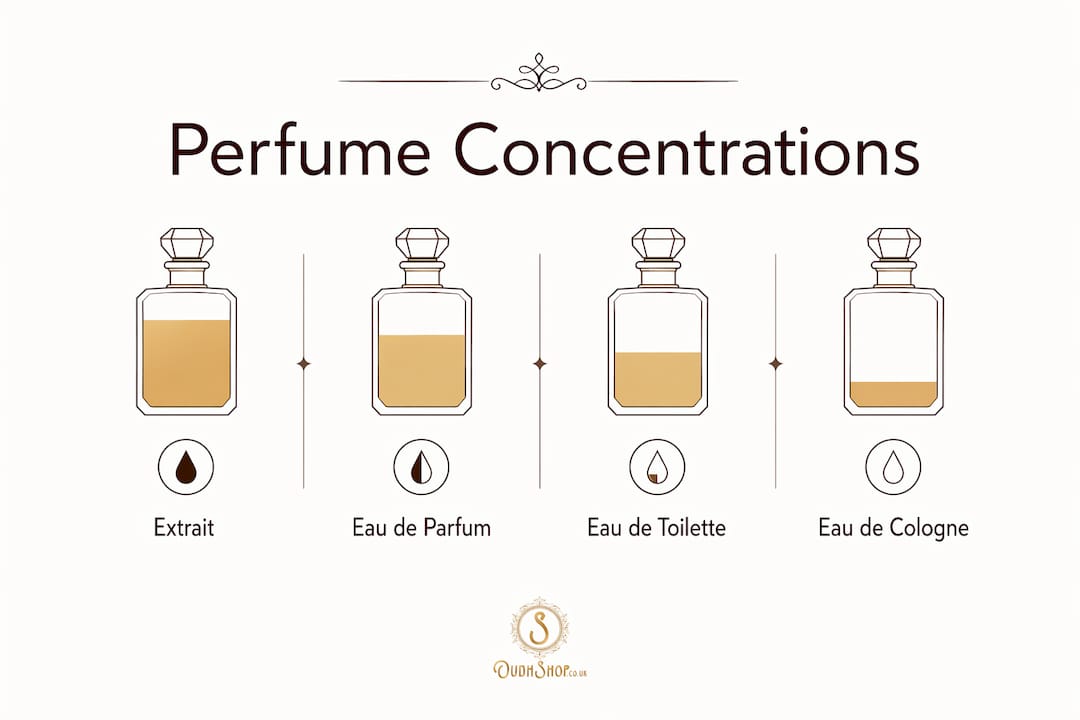
Defining perfume concentrations begins with knowing the four principal tiers that structure the entire fragrance market. Each category carries a typical oil percentage range, and that range directly predicts wear time and projection.
| Concentration type | Fragrance oil % | Typical longevity | Best suited for |
|---|---|---|---|
| Eau de Cologne (EdC) | 2–5% | 2–3 hours | Warm weather, casual daytime |
| Eau de Toilette (EdT) | 5–15% | 3–5 hours | Office, daytime, light occasions |
| Eau de Parfum (EdP) | 15–20% | 5–8 hours | Evening, cooler weather, daily wear |
| Parfum / Extrait | 20–40% | 8–24 hours | Special occasions, intimate wear |
Typical concentration ranges place Eau de Cologne at 2–5%, Eau de Toilette at 5–15%, Eau de Parfum at 15–20%, and Parfum at 20–40%. These figures are not arbitrary. A higher oil load means more aromatic molecules available to evaporate from your skin over time, which extends the scent arc from opening top notes through to the warm, resinous base.
Eau de Toilette is the most widely produced concentration globally, favoured for its balance of presence and lightness. It suits office environments and warm climates where a heavy sillage would feel intrusive. EdP lasts 5–8 hours on skin, making it the preferred choice for those who want a single application to carry them through a full working day and into the evening. Parfum, sitting at the apex, can last 8–24 hours and is the natural choice for special occasions or anyone who values depth and tenacity above all else.
- Eau de Cologne works beautifully as a post-shower refresh or a light summer companion, but expect to reapply after a few hours.
- Eau de Toilette offers the widest variety of available fragrances and the most accessible price points.
- Eau de Parfum delivers the best balance of longevity and wearability for most lifestyles.
- Parfum / Extrait carries the richest, most complex scent development, with base notes of Agarwood, sandalwood, or musk revealing themselves slowly over many hours.
Pro Tip: If you are new to a fragrance house, start with the EdT or EdP version before investing in the Extrait. The character of the scent shifts between concentrations, and the lighter version lets you assess whether the fragrance suits your skin before committing to the most expensive tier.
Does formulation affect scent beyond the oil percentage?
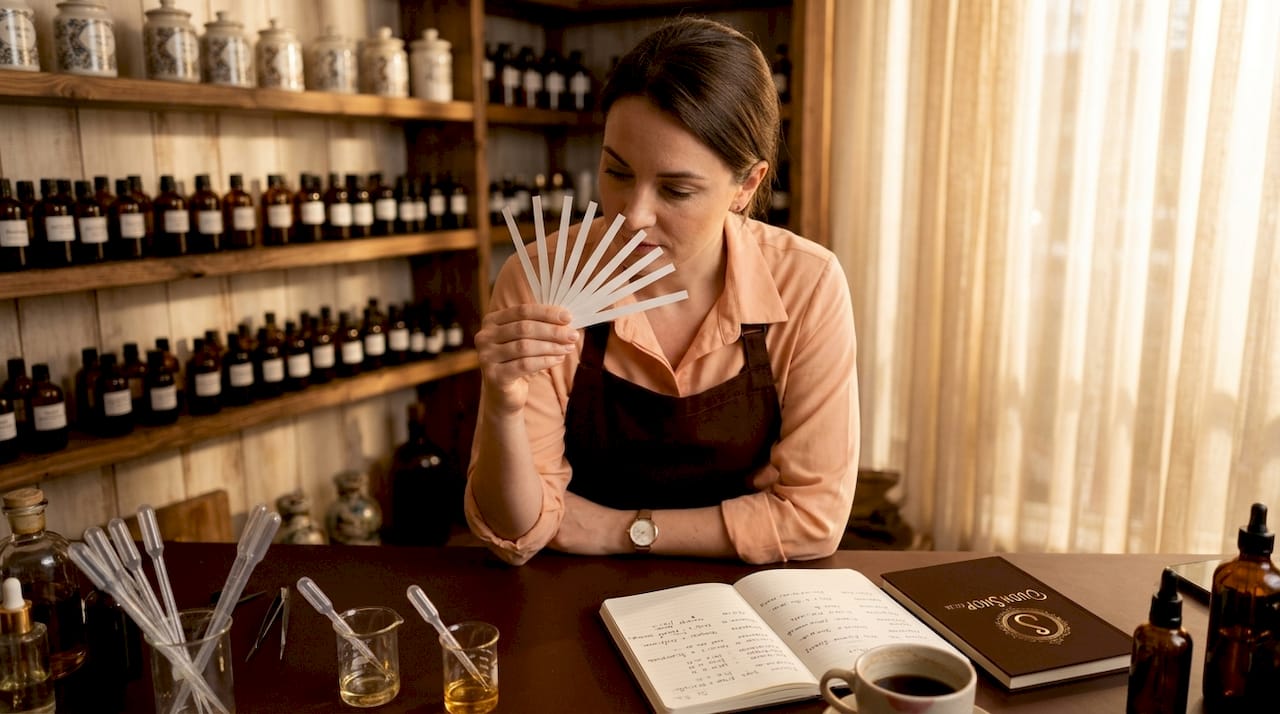
Concentration percentage is a useful starting point, but it does not tell the whole story. Solvent system, fixatives, and formula design all influence how a fragrance evaporates, develops, and clings to skin, sometimes more decisively than the oil percentage itself.
The carrier alcohol used in a fragrance affects how quickly the top notes bloom and how cleanly the base notes emerge. High-purity perfumers’ alcohol allows aromatic molecules to disperse freely, creating a bright, immediate opening. A lower-grade solvent can mute the top notes and create a heavier, less refined dry-down. Fixatives, which are ingredients like Agarwood resin, ambergris, or synthetic musks, anchor the volatile top and heart notes to the skin, slowing their evaporation and extending the overall wear time.
This is why two fragrances labelled as Eau de Parfum at 15% can perform entirely differently on your skin. One may fade within four hours while the other lingers warmly for eight. The difference lies in the fixative load, the volatility profile of the aromatic materials, and the deliberate architecture of the formula.
“Concentration is a useful shortcut for predicting wear time, but volatility, fixatives, and solvent system strongly influence scent behaviour.” — Luxsure Fragrance Analysis
The role of the International Fragrance Association (IFRA) is frequently misunderstood in this context. IFRA concentration limits are safety ceilings per product category, not performance indicators or targets for scent strength. A perfumer working within IFRA guidelines is meeting a regulatory safety requirement, not calibrating the fragrance for maximum longevity. This distinction matters because it explains why two compliant fragrances at the same concentration can smell and perform very differently.
How to choose the right perfume concentration for your needs
Selecting the right concentration is less about prestige and more about matching the fragrance to your life. Consider these four factors before purchasing:
Wear time required. If you need a scent to last through a 10-hour day without reapplication, an EdP or Parfum is the practical choice. For a two-hour lunch or a gym session, an EdC or EdT is entirely sufficient and more economical.
Occasion and setting. Intimate dinners and evening events reward the depth of an Extrait de Parfum, where the slow unfurling of smoky Agarwood or sensual musk becomes part of the experience. Open-plan offices and crowded commutes call for the lighter sillage of an EdT, where consideration for others is part of wearing fragrance well.
Seasonal suitability. Heat amplifies fragrance projection. A heavy EdP that smells exquisite in winter can become overwhelming in July. Many fragrance lovers maintain a warmer-weather EdT and a cooler-weather EdP of the same or complementary scent families. Higher concentration correlates with stronger scent development and complexity, but also with a higher risk of overpowering in warm conditions.
Budget and value. Parfum commands a premium price because the raw material cost is proportionally higher. However, you use significantly less per application. A 30ml Extrait applied sparingly often outlasts a 100ml EdT in terms of total wearings, making the cost-per-wear calculation more favourable than the bottle price suggests.
Pro Tip: Apply fragrance to pulse points such as the wrists, neck, and inner elbows, where body heat naturally diffuses the scent. Moisturised skin retains fragrance longer than dry skin, so an unscented body lotion applied before your perfume is one of the most effective ways to extend wear time regardless of concentration. For more detailed guidance, explore these perfume application tips to get the most from every spray.
Common misconceptions about perfume concentrations
Several persistent myths circulate about fragrance strength, and they lead to poor purchasing decisions. Understanding the nuances separates informed fragrance lovers from those perpetually disappointed by their choices.
Parfum does not always project the furthest. Because Extrait de Parfum contains a higher proportion of heavy base-note materials, its sillage is often more intimate and close-to-skin than an EdT of the same fragrance. The lighter, more volatile molecules in an EdT radiate outward more aggressively. This is why a Parfum feels like a second skin while an EdT announces your presence across a room.
An EdT is not simply a diluted EdP. Perfumes with identical labels can smell entirely different because brands reformulate the composition at each concentration tier rather than simply adding more alcohol. Chanel No. 5 EdT and Chanel No. 5 EdP are distinct formulas with different aromatic characters, not the same juice at different strengths. This is a masterful commercial and artistic decision, not a shortcut.
Concentration labels are not legally standardised. No widely binding ISO standards mandate minimum aromatic concentration levels for consumer fragrance labels. This means a brand can technically label a product as Eau de Parfum without meeting any externally verified oil percentage. Industry convention governs these names, not enforceable regulation. The implication is clear: the label is a guide, not a guarantee.
“The concentration label tells you what a brand intends the fragrance to be. The formula tells you what it actually is. Always test before you commit.”
Skin chemistry alters everything. Two people wearing the same EdP will experience different longevity, projection, and even scent character. Skin pH, natural oils, diet, and body temperature all interact with fragrance molecules in ways no concentration figure can predict. Testing on your own skin remains the only reliable method for understanding how a fragrance will truly perform for you.
Key takeaways
Perfume concentration defines the percentage of fragrance oil in a formula, and while it predicts wear time, formulation quality, fixatives, and skin chemistry determine the full scent experience.
| Point | Details |
|---|---|
| Concentration tiers | EdC (2–5%), EdT (5–15%), EdP (15–20%), and Parfum (20–40%) each deliver distinct longevity and projection. |
| Formulation matters | Fixatives, solvent quality, and formula design influence performance as much as the oil percentage itself. |
| IFRA limits are safety rules | IFRA guidelines set safety ceilings for ingredients, not performance targets or strength indicators. |
| Labels are not standardised | No binding ISO standard enforces concentration percentages, so the label reflects brand convention, not regulation. |
| Match concentration to lifestyle | Choose EdT for daytime and warm weather, EdP for all-day wear, and Parfum for special occasions and intimate settings. |
What I have learnt from years of working with fragrance concentrations
The single most common mistake I see fragrance lovers make is treating concentration as a quality hierarchy. Parfum is not inherently better than Eau de Toilette. It is a different tool for a different purpose, and the finest EdT, built with exquisite materials and masterful fixation, will outperform a poorly formulated Extrait every time.
What genuinely surprises people is how much the solvent system shapes their experience. I have worn two fragrances at identical EdP concentrations where one faded within three hours and the other was still perceptible the following morning. The difference was entirely in the fixative architecture and the quality of the Agarwood base. Concentration gave me a starting point. The formula delivered the reality.
My advice is to use the fragrance concentration guide as a map, not a destination. Sample widely. Test on skin, not paper. Pay attention to how a fragrance develops over four to six hours rather than judging it on the opening alone. The base notes, those deep, resinous, woody, or musky foundations, are where the true character of a perfume lives. And those base notes only reveal themselves with time and warmth.
Layering is another dimension most people overlook. A lighter EdT worn over a complementary body oil or musk can create a personalised sillage that no single bottle achieves alone. This is how Middle Eastern perfumery has approached fragrance for centuries, and it remains one of the most rewarding ways to wear scent.
— Oudh
Discover your perfect concentration at Oudhshop
At Oudhshop, every fragrance in our collection is selected with concentration and longevity at the forefront. Whether you are drawn to the smoky depth of an Extrait de Parfum built around liquid-gold Agarwood, or the vibrant freshness of a lighter EdT for daily wear, our curated range spans every tier of fragrance strength.
Our oud and musk perfumes are formulated for genuine all-day performance, drawing on the rich heritage of Arabian perfumery where longevity is not a luxury but a standard. For those who want to explore before committing, our travel-size perfumes let you test different concentrations on your own skin before investing in a full bottle. Looking for a considered gift? Our perfume gift sets present curated concentrations beautifully, making them the ideal introduction to the world of oud for someone you care about.
FAQ
What does perfume concentration actually mean?
Perfume concentration refers to the percentage of fragrance oil in a formula relative to the carrier, usually alcohol. A higher percentage means a stronger, longer-lasting scent.
Is Eau de Parfum always stronger than Eau de Toilette?
EdP typically contains more fragrance oil and lasts longer on skin, but an EdT of the same fragrance may project further due to its higher proportion of volatile top-note materials.
Why do some EdTs last longer than some EdPs?
Longevity depends on fixatives, solvent quality, and formula design, not concentration alone. A well-fixed EdT with heavy base notes can outlast a poorly formulated EdP on the same skin.
Are perfume concentration labels legally regulated?
No binding ISO standard enforces minimum oil percentages for fragrance labels. Concentration naming follows industry convention, which means the label is a guide rather than a guaranteed specification.
How do I choose between EdT and EdP for everyday wear?
EdT suits daytime, warm weather, and office environments where lighter projection is appropriate. EdP is the better choice for all-day wear, cooler seasons, and occasions where you want the fragrance to carry through from morning to evening without reapplication.