
Luxury Arabian Oud Perfume Blog: Your Guide to Exquisite Fragrances
What is a fragrance pyramid? A perfumer’s guide

TL;DR:
- A fragrance pyramid divides perfumes into top, heart, and base notes, illustrating how scents evolve over time. It reflects evaporation rates based on molecular weight, guiding perfume selection, layering, and understanding of quality. The pyramid’s limitations highlight the importance of complementary tools like the fragrance wheel and awareness of personal skin chemistry.
A fragrance pyramid is the structured model dividing a perfume into three distinct layers: top, heart, and base notes, each representing a different phase of a scent’s evolution on skin. Systematised in the 20th century by the celebrated perfumer Jean Carles), this framework organises ingredients by their evaporation rates, from the lightest, most volatile molecules to the richest, most tenacious ones. Understanding the fragrance pyramid transforms the way you shop for, wear, and layer perfumes. It is the difference between choosing a scent that dazzles for ten minutes and one that tells a story across an entire day.

What is a fragrance pyramid and how does it work?
A fragrance pyramid is defined as a three-tier model that maps how a perfume’s scent evolves over time, from the first spray to the final dry-down hours later. The structure is shaped like a triangle: the narrow apex holds the fleeting top notes, the broad middle contains the heart notes, and the wide base anchors the composition with long-lasting depth. Each tier corresponds to a different molecular weight range and evaporation speed, which is why you smell something bright and citrusy the moment you apply a perfume, then something warmer and richer an hour later.
The model is grounded in genuine chemistry. Perfume molecules evaporate at different speeds based on molecular weight and vapour pressure, a relationship described by the Clausius-Clapeyron relation. Lighter molecules escape the skin surface quickly, while heavier ones cling and linger. This is not a marketing invention; it is physics made wearable.
That said, the pyramid is also a marketing tool, and it remains a simplified, marketing-friendly representation) rather than a full scientific model. Perfume houses use it to communicate a fragrance’s character and journey, though the reality of how notes interact is considerably more nuanced than a tidy triangle suggests.
What are top, heart, and base notes in the fragrance pyramid?
Each tier of the pyramid has a distinct role, a characteristic lifespan, and a set of ingredients that perfumers reach for most often.
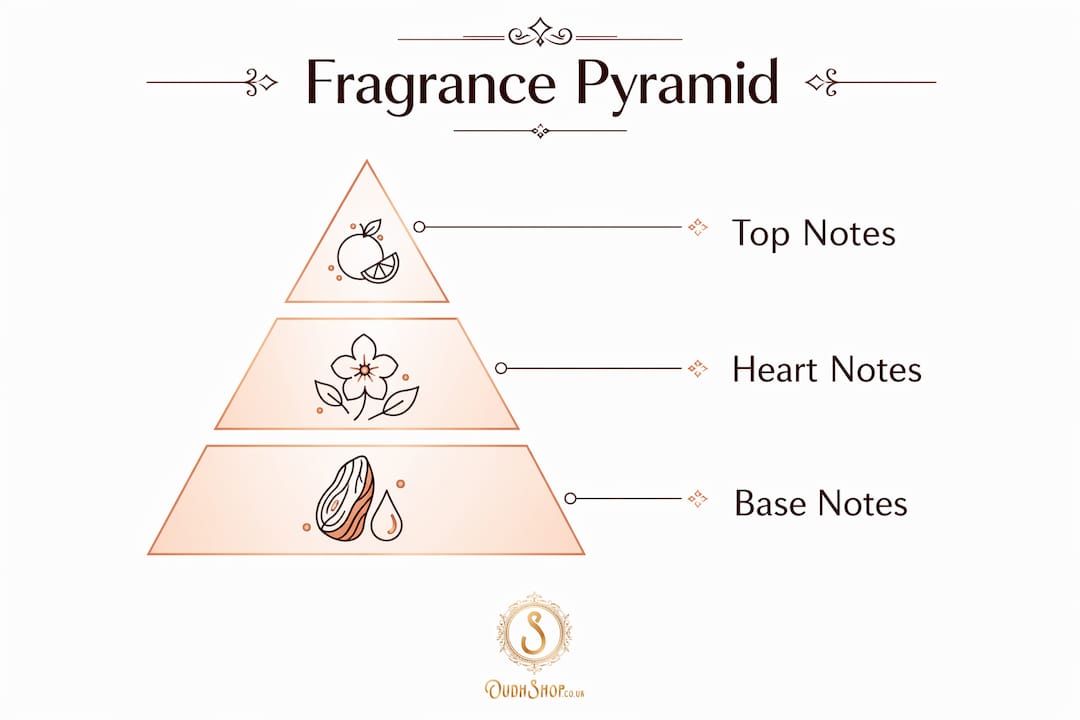
Top notes: the first impression
Top notes are the lightest, most volatile components in a fragrance. They are what you smell the moment a bottle is uncapped or a perfume is sprayed onto skin. Top notes typically evaporate within 15 to 30 minutes, which means they are the shortest-lived element of the pyramid. Their molecular weights generally fall in the range of 130 to 180 g/mol, making them the lightest molecules in the composition.
Common top note ingredients include bergamot, lemon, grapefruit, basil, and light herbs. These ingredients are chosen precisely because they are bright, clean, and immediately appealing, creating the crucial first impression that determines whether someone reaches for a bottle in a shop. Think of them as the opening line of a poem: vivid, arresting, and gone before you have fully absorbed them.
Heart notes: the soul of the fragrance
Heart notes, also called middle notes, form the core identity of a perfume. They emerge as the top notes fade, typically becoming prominent within 20 to 30 minutes of application, and they last between 1 and 4 hours on the skin. Their molecular weights sit in the middle range, heavier than top notes but lighter than base notes.
Heart notes include florals, spices, and green notes) such as rose, jasmine, geranium, cinnamon, and cardamom. These are the ingredients that define whether a fragrance reads as a romantic floral, a spiced oriental, or a crisp green composition. A perfumer’s skill is most visible here, because the heart must both stand alone and serve as a bridge between the opening brightness and the deep, anchoring base.
Base notes: the lasting signature
Base notes are the heaviest, most tenacious molecules in a fragrance. They become fully perceptible once the heart notes begin to fade, and they persist for 4 to 12 or more hours on the skin. Their molecular weights typically range from 200 to 300 g/mol, which is why they cling so effectively to fabric and skin alike.
Typical base note ingredients include Agarwood (oud), sandalwood, vetiver, patchouli, musks, ambers, and resins. These are the ingredients that give a fragrance its depth, warmth, and lasting sillage. In Middle Eastern perfumery, oud and musk are prized precisely because they are masterful base note materials, capable of anchoring a composition for an entire day and beyond.
Pro Tip: When testing a new perfume, wait at least 30 minutes before making a decision. The top notes you smell at the counter are not the fragrance you will wear all day. The heart and base notes reveal the true character of the composition.
| Pyramid tier | Typical ingredients | Evaporation time |
|---|---|---|
| Top notes | Bergamot, lemon, basil, grapefruit | 15 to 30 minutes |
| Heart notes | Rose, jasmine, cardamom, cinnamon | 1 to 4 hours |
| Base notes | Oud, sandalwood, musk, amber, resins | 4 to 12+ hours |
How does fragrance pyramid chemistry actually work?
The pyramid exists because of a fundamental physical principle: not all molecules evaporate at the same rate. A perfume is a cocktail of molecules dissolved in alcohol, and when you spray it onto skin, the alcohol evaporates first, carrying the lightest scent molecules with it. What follows is a stepwise release of heavier and heavier molecules, which is precisely the temporal unfolding the pyramid describes.
The sequence works as follows:
- Alcohol evaporates within seconds of application, releasing the top note molecules into the air around you.
- Top note molecules (low molecular weight, high vapour pressure) escape the skin surface rapidly, creating the vivid opening accord.
- Heart note molecules (medium molecular weight) begin to warm on the skin and become perceptible as the top notes dissipate.
- Base note molecules (high molecular weight, low vapour pressure) are the last to volatilise, releasing slowly and consistently over many hours.
“The pyramid is not a recipe; it is a timeline. Every fragrance tells its story in sequence, and understanding that sequence is what separates a considered choice from a lucky guess.”
This chemistry also explains why the same perfume can smell different on two people. Skin temperature, pH, and hydration levels all affect evaporation rates, which means the pyramid is a guide, not a guarantee. A warm skin tone will accelerate evaporation across all tiers, making a fragrance feel more intense but potentially shorter-lived.
What are the limitations and nuances of the fragrance pyramid?
The pyramid is a genuinely useful framework, but it has real limitations that every informed fragrance lover should understand.
The most significant limitation is that the pyramid describes when you smell something, not what you smell or why it works. It captures the time and volatility dimension of a fragrance but says nothing about scent family, character, or aesthetic relationships between ingredients. For that, you need the fragrance wheel by Michael Edwards, which maps scent families and their relationships to one another. The pyramid and the fragrance wheel are complementary tools. Used together, they give you a complete picture of a fragrance’s structure and character.
A second limitation is that pyramid layers overlap in molecular weight and evaporation time, so the transition between notes is gradual rather than discrete. You do not experience a clean switch from top to heart notes at the 30-minute mark. Instead, the notes blend and blur at the edges, which is part of what makes a well-constructed fragrance feel cohesive rather than disjointed.
The pyramid also has a marketing dimension that warrants scepticism. Overuse of top notes or a lack of defined base notes often signals poor perfume quality or the use of synthetic fillers. Some perfume houses inflate their listed top notes to make a composition sound more complex than it is, while underrepresenting the base, which is where genuine craftsmanship and expensive raw materials tend to live. A balanced pyramid with defined base notes generally indicates higher perfume craftsmanship.
Pro Tip: When reading a fragrance pyramid on a product page, pay particular attention to the base notes. Rich, named base materials such as Agarwood, vetiver, or genuine musk signal a fragrance built to last. Vague descriptors like “woody accord” or “musky base” can indicate synthetic substitutes.
- The pyramid describes volatility and time, not scent family or aesthetic character.
- Transitions between tiers are gradual, not sudden.
- Marketing pyramids can misrepresent quality by overloading top notes.
- Personal skin chemistry alters how the pyramid unfolds on each wearer.
- The fragrance wheel by Michael Edwards is the essential companion tool for understanding scent families.
How can the fragrance pyramid improve your scent layering?
Understanding fragrance pyramids aids in effective scent layering and perfume selection, helping you create harmonious, lasting scent experiences rather than accidental clashes. The pyramid gives you a practical framework for combining fragrances intelligently.
When layering two perfumes, consider the base notes of both. If they share a common base material, such as oud, sandalwood, or musk, the two fragrances will blend naturally at the skin level and create a unified dry-down. Layering a citrus-forward fragrance over a deep musk base, for example, allows the citrus top notes to provide freshness while the musk anchors the combination with warmth and longevity.
Timing also matters when layering. Apply your base-heavy fragrance first and allow it to settle for a few minutes before applying a lighter fragrance on top. This sequence mirrors the pyramid’s own logic: the heavier molecules bond to the skin first, and the lighter ones are released into the air above them, creating a natural, multi-dimensional scent profile.
When selecting a single perfume for longevity, look for compositions with rich, clearly defined base notes and a balanced heart. Extrait de Parfum concentrations carry a higher proportion of base note materials than Eau de Toilette, which is why they last significantly longer on the skin. Understanding perfume concentration differences is the natural next step once you have grasped the pyramid.
| Layering goal | Pyramid strategy |
|---|---|
| Maximum longevity | Choose two fragrances sharing the same base note family |
| Complexity and depth | Layer a floral heart over a woody or resinous base |
| Freshness with staying power | Apply a citrus top note fragrance over a musk base fragrance |
| Signature scent creation | Combine complementary heart notes from different compositions |
For practical guidance on application technique, the perfume application tips at Oudhshop cover how pulse points, skin hydration, and layering order all affect how the pyramid unfolds throughout the day.
Key takeaways
The fragrance pyramid is the single most useful framework for understanding how a perfume evolves, but it must be read alongside the fragrance wheel and with an awareness of its marketing limitations.
| Point | Details |
|---|---|
| Three-tier structure | Top, heart, and base notes each represent a distinct evaporation phase on skin. |
| Chemistry drives the sequence | Molecular weight determines evaporation speed, from 130 g/mol top notes to 300 g/mol base notes. |
| Pyramid has marketing limits | Inflated top note lists can mask weak base notes and lower-quality ingredients. |
| Fragrance wheel complements the pyramid | Use Michael Edwards’ fragrance wheel alongside the pyramid to understand scent families fully. |
| Layering benefits from pyramid knowledge | Matching base notes across fragrances creates harmonious, long-lasting layered compositions. |
Why the pyramid matters more than most people realise
The fragrance pyramid is often treated as a beginner’s concept, something you learn once and then set aside. I think that is a mistake. The more time you spend with fine fragrances, the more the pyramid reveals. It is not just a diagram on a product page; it is a map of a perfumer’s intentions.
What I find most revealing is the base note tier. In my experience, the base notes tell you more about a perfume’s quality and ambition than anything else. A fragrance that opens with dazzling bergamot and fades to nothing within an hour has been built for the counter, not for the wearer. A fragrance anchored in genuine Agarwood, vetiver, or aged musk is built to accompany you through the day, deepening and shifting as your skin warms it.
The pyramid’s limitations are real, and I would encourage anyone serious about fragrance to explore the fragrance wheel explanation alongside it. The wheel tells you what a fragrance smells like in terms of family and character; the pyramid tells you when and how long. Neither is complete without the other.
The most exciting development in contemporary perfumery is the deliberate subversion of the pyramid. Some modern perfumers, particularly within the Middle Eastern tradition, construct fragrances that are intentionally base-heavy from the first spray, with oud or musk present at full intensity from the opening. This challenges the Western pyramid model and produces a very different wearing experience, one that is immediate, enveloping, and extraordinarily long-lasting. It is worth knowing the rules before you appreciate how masterfully some perfumers choose to break them.
— Oudh
Discover long-lasting fragrances built on rich base notes
At Oudhshop, every fragrance in our collection is chosen with the base note tier in mind. Oud and musk are among the most tenacious and exquisite base note materials in perfumery, which is why our full fragrance collection is built around them. Whether you are searching for a single signature scent or exploring the art of layering, our range offers compositions with clearly defined pyramids and extraordinary longevity. If you are new to oud or want to experiment before committing, our travel-size perfumes let you explore the full pyramid evolution of a fragrance across a day’s wear. For a curated recommendation matched to your preferences, try our perfume finder and discover your signature scent.
FAQ
What is a fragrance pyramid in simple terms?
A fragrance pyramid is a three-tier model dividing a perfume into top, heart, and base notes, each representing a different phase of the scent’s evolution on skin. The tiers are ordered by evaporation speed, from the lightest and most fleeting to the heaviest and most long-lasting.
How long do top, heart, and base notes last?
Top notes typically evaporate within 15 to 30 minutes, heart notes last between 1 and 4 hours, and base notes persist for 4 to 12 or more hours. These durations vary depending on skin chemistry, temperature, and fragrance concentration.
What is the difference between the fragrance pyramid and the fragrance wheel?
The fragrance pyramid describes when and how long you smell each layer of a perfume, based on volatility. The fragrance wheel, developed by Michael Edwards, maps scent families and their aesthetic relationships. Both tools are needed for a complete understanding of any fragrance.
Can the fragrance pyramid help with scent layering?
The pyramid is a practical guide for layering because matching base notes across two fragrances creates a harmonious, unified dry-down. Applying the heavier, base-rich fragrance first and the lighter fragrance on top mirrors the pyramid’s own logic and produces a more cohesive result.
Why do some perfumes smell different on different people?
Skin temperature, pH, and hydration levels all affect evaporation rates, which means the pyramid unfolds differently on each wearer. A warmer skin tone accelerates evaporation across all tiers, making a fragrance feel more intense but potentially shorter-lived than on cooler skin.