Luxury Arabian Oud Perfume Blog: Your Guide to Exquisite Fragrances
What is fragrance concentration? A complete guide
TL;DR:
- Fragrance concentration measures aromatic compounds as a percentage of the total formula, impacting longevity and scent character. Higher concentration does not always mean louder projection, as projection depends on molecular volatility and fixatives. Choosing the right concentration requires considering occasion, skin chemistry, and personal preference for intimacy or presence.
Most people choose a perfume based on how it smells in the bottle or on a strip. Very few stop to consider what is fragrance concentration and how dramatically it shapes the scent they will actually wear on skin, hours into the day. That oversight leads to purchases that disappoint: a bottle that fades within two hours, or a scent so dense it overwhelms a room. Understanding fragrance concentration meaning gives you the knowledge to choose deliberately, not by accident, and to get genuinely remarkable longevity from every spray.
Table of Contents
- Key takeaways
- What fragrance concentration really means
- Concentration, longevity, and projection
- Regulations and their impact on concentration
- How to choose the right fragrance concentration
- My honest perspective on concentration labels
- Explore Oudhshop’s range by concentration
- FAQ
Key takeaways
| Point | Details |
|---|---|
| Concentration is a percentage | Fragrance concentration measures aromatic compounds as a proportion of the total formula, from roughly 1% up to 40%. |
| Higher does not always mean louder | Greater concentration can produce an intimate, slower-diffusing aura rather than bold projection, depending on the formula. |
| Longevity follows concentration | Eau de Parfum typically lasts 6 to 10 hours; Extrait de Parfum can exceed 24 hours on warm skin. |
| Regulations shape the formula | IFRA standards limit specific ingredients in the finished product, which can force reformulation at higher concentrations. |
| Test before committing | Wearing a fragrance at different concentrations on your own skin remains the most reliable way to choose the right one. |
What fragrance concentration really means
At its most precise, fragrance concentration is the percentage of aromatic compounds relative to solvents and carrier bases within a finished perfume formula. Those aromatic compounds are the fragrance oil, a blend of natural extracts, synthetic molecules, and fixatives that create the scent. Everything else in the bottle, predominantly alcohol and occasionally water or a neutral oil, serves to dilute and carry them.
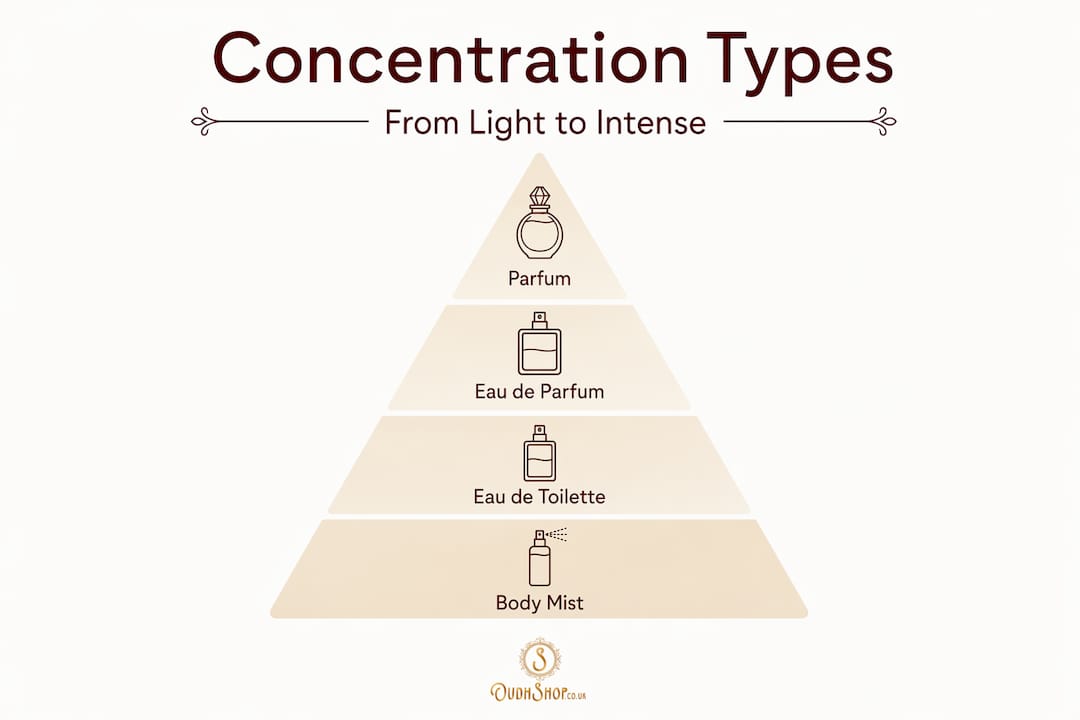
The practical result of this is a spectrum of categories, each with an established concentration range and a distinct character.
| Category | Typical concentration | Expected longevity | Character |
|---|---|---|---|
| Body mist / cologne | 1–3% | 1–2 hours | Light, fresh, casual |
| Eau de Cologne (EdC) | 2–5% | 2–3 hours | Citrus-forward, airy |
| Eau de Toilette (EdT) | 5–15% | 3–6 hours | Vibrant, versatile |
| Eau de Parfum (EdP) | 15–20% | 6–10 hours | Rich, complex, rounded |
| Parfum / Extrait de Parfum | 20–40% | 8–24+ hours | Dense, intimate, luxurious |
| Attar / Perfume oil | 20–100% | 8–24+ hours | Skin-close, alcohol-free |
It is worth noting that categories are not legally standardised across every country, so you will occasionally encounter an EdP from one house that outperforms an Extrait from another. The label is a guide, not a guarantee.
Price follows concentration closely. Higher concentration formulas demand more costly raw materials and greater formulation complexity, which is why an Extrait de Parfum or a pure attar commands a premium compared to its Eau de Toilette counterpart. When you pay more for a concentrated perfume, you are paying for the raw material inside the bottle, not merely the packaging.
For those who want to understand differences between perfume types in greater depth, the relationship between concentration and scent character becomes even richer once you explore how houses position each tier within their collections.
Concentration, longevity, and projection
Here is where fragrance concentration explained in most mainstream guides falls short. The assumption is simple: more concentration equals stronger, longer-lasting scent. Reality is considerably more layered.
Higher concentration generally increases longevity but does not guarantee stronger projection. Projection, the distance at which others can detect your fragrance, depends primarily on the volatility of the aromatic molecules and the presence of fixatives in the formula. A lightly concentrated EdT built around sharp citrus and bright florals can project across a room far more assertively than a dense Extrait heavy with resins, Agarwood, and musks.

Think of it this way. An Extrait de Parfum rich in sandalwood, amber, and oud behaves like liquid gold pressed close to the skin. It is warm, sensual, and extraordinarily lasting, but its scent unfolding feels denser and slower, diffusing in a tight, intimate aura rather than radiating outward. An Eau de Toilette with volatile green notes and citrus top notes, by contrast, announces itself freely but fades within hours.
Understanding this distinction requires separating three concepts:
- Longevity refers to how many hours the scent remains detectable on your skin. Typical ranges run from 3 to 6 hours for EdT, 6 to 10 hours for EdP, and 8 to 24 or more hours for Parfum or Extrait.
- Projection (sometimes called “throw”) describes how far the scent radiates from your body into the surrounding space. Volatile top and heart notes drive this more than concentration alone.
- Sillage is the trail of scent you leave as you move. A masterful guide to perfume sillage will explain how sillage is shaped by base notes, skin chemistry, and fixative use. Concentration influences it, but never exclusively.
What this means practically is that stronger concentration does not always equal a louder scent. Some of the most discreet, skin-hugging fragrances in the world are Extraits, while some of the most assertive are mid-range EdTs.
Pro Tip: If you want genuine longevity without overwhelming projection, choose a high-concentration formula built on woody, musky, or resinous base notes. Apply to pulse points such as wrists, inner elbows, and the base of the neck, and allow the warmth of your skin to diffuse the scent naturally.
Regulations and their impact on concentration
Understanding fragrance strength is only half the picture. The other half belongs to regulatory frameworks that quietly govern what can go into a high-concentration formula.
The International Fragrance Association (IFRA sets maximum permitted concentrations) for specific fragrance ingredients in finished products. These limits are exposure-based and vary by product category, with leave-on skin products like perfumes subject to stricter limits than rinse-off or non-skin products. The critical point is that IFRA limits apply to the finished product formula, not to the fragrance oil concentrate in isolation.
This creates a formulation challenge that most consumers never see. When a perfumer increases the concentration of a fragrance oil from 15% to 30%, the quantities of every restricted ingredient in the finished product double proportionally. If any of those ingredients exceed their IFRA threshold at the higher concentration, the entire formula must be adjusted to stay compliant.
In practice, this means:
- Reformulation is often necessary. Raising concentration is not as simple as adding more oil. Perfumers must recalculate ingredient percentages and reduce restricted materials within the concentrate to maintain compliance at the higher finished-product level.
- Certain naturals become harder to use at high concentrations. Oakmoss, citrus bergapten compounds, and some jasmine absolutes carry strict limits, making them difficult to feature generously in an Extrait formulation.
- Synthetic alternatives gain importance. At high concentrations, safe and IFRA-compliant synthetic molecules often replace or supplement naturals that would otherwise breach limits, which is one reason why attars and pure oils from heritage perfumery traditions occupy a distinct space from regulated EdP and Extrait formulations.
- Product category matters. IFRA divides products into exposure categories, from high-risk leave-on items applied near sensitive areas to low-risk non-contact products. Perfumes fall into a category that demands careful ingredient management, particularly at higher concentrations.
The result is that producing a genuinely excellent high-concentration fragrance is a technically demanding achievement, not merely a matter of using more oil.
How to choose the right fragrance concentration
Armed with this knowledge, choosing a concentration becomes far more deliberate and rewarding. Rather than defaulting to whatever the counter recommends, consider these factors carefully.
Occasion and environment. A professional setting or a warm, confined space calls for restraint. An EdT or a lightly applied EdP serves beautifully in meetings or on public transport. For an evening event, a formal dinner, or an outdoor occasion in cooler weather, a richer EdP or Extrait rewards the atmosphere.
Skin type and chemistry. Dry skin absorbs fragrance faster and holds it less effectively than oily skin. If your skin tends to drink scent quickly, a higher concentration or a perfume oil will compensate. Moisturised skin, or skin treated with an unscented lotion before applying fragrance, helps any concentration perform better.
Desired intimacy versus presence. There is a meaningful distinction between fragrances that others notice when they stand near you and fragrances that announce your arrival before you enter the room. High-concentration resinous or woody scents tend toward intimacy. Lighter, more volatile formulas at lower concentrations tend toward presence.
Here are the key considerations to weigh before choosing:
- Do you want the scent to last through a full working day without reapplication? Opt for EdP or above.
- Are you buying for a casual, daytime, or outdoor setting? An EdT often provides ideal balance.
- Do you find heavy projection uncomfortable or intrusive? A concentrated perfume oil or attar applied sparingly creates a beautiful skin scent with minimal sillage.
- Are you new to a particular fragrance family? Start with an EdT to understand the composition before committing to a denser format.
- Do you enjoy layering? Lighter concentrations layer more forgivingly. Explore the craft of scent layering with oud fragrances to build complex, personal compositions.
Seasonally, lighter concentrations tend to feel more harmonious in warm weather, when skin temperature accelerates diffusion and heavier formulas can become overwhelming. In autumn and winter, the skin holds heat less easily outdoors, making a denser Extrait or a rich EdP the wiser choice.
Pro Tip: When testing a new concentration, apply to bare skin and wait a full 30 minutes before making any judgement. The opening spray rarely reflects the true character of the fragrance. The heart and base notes, which emerge as the volatile top notes settle, reveal what you will actually wear throughout the day.
My honest perspective on concentration labels
Over years of working closely with perfumers and exploring hundreds of formulas, I have come to see fragrance concentration as the tempo of a scent rather than its volume. It tells you how quickly or slowly the composition will reveal itself, and how tightly it will hold to the skin. That is genuinely useful information. But it is not the whole story, and treating it as such leads to disappointment.
I have smelled Extrait de Parfums that barely whispered and Eau de Toilettes that filled a room for hours. What made the difference was never the percentage. It was the skill of the formulation, the volatility profile of the chosen molecules, and the quality of the raw materials. Concentration is best understood as a guide to scent unfolding tempo, not as an absolute measure of strength or presence.
My honest advice is to use concentration as a starting point, not a destination. If you want a scent that lasts all day without any fuss, begin with an EdP or a concentrated attar. If you want freedom and freshness for warm weather or casual wear, an EdT is perfectly honourable. Then, once you have lived with a fragrance across different seasons and occasions, you will develop your own instinct for what serves you. The label tells you where to start. Your skin and your experience tell you where to stay.
— Oudh
Explore Oudhshop’s range by concentration
At Oudhshop, we believe that understanding fragrance concentration should make choosing your next bottle genuinely pleasurable rather than overwhelming. Our collection spans the full spectrum, from vibrant, travel-friendly Eaux de Toilette to dense, long-lasting Extraits and pure attar oils drawn from the heart of Middle Eastern perfumery.
Whether you are beginning your exploration or refining a well-developed collection, our Perfume Finder tool lets you filter by strength, scent family, and occasion to discover the concentration that suits your lifestyle. If you prefer to experience before committing, our perfume testers let you wear a scent properly before investing in a full bottle. For those who are drawn to the rich, resinous depth of high-concentration oud and Arabian fragrances, browse the full Oudhshop collection to find formulas that reward patience and wear beautifully from morning through to evening.
FAQ
What does fragrance concentration mean?
Fragrance concentration refers to the percentage of aromatic compounds within a perfume formula relative to the total volume. Higher percentages produce longer-lasting, denser scents, while lower percentages create lighter, more volatile compositions.
Which fragrance concentration lasts the longest?
Parfum and Extrait de Parfum, with concentrations of 20 to 40%, typically last the longest, often 8 to 24 or more hours on skin. Pure attar oils can also deliver exceptional longevity due to their high fragrance content and alcohol-free bases.
Does higher concentration always mean stronger projection?
No. Projection depends more on volatility and molecular composition than on concentration alone. A high-concentration formula built on heavy resins and woods may project intimately, while a lower-concentration EdT with bright citrus notes can radiate assertively.
How do IFRA regulations affect fragrance concentration?
IFRA sets maximum permitted ingredient concentrations in finished perfume products. When formulators raise a fragrance’s overall concentration, they must reduce restricted ingredients within the concentrate to stay compliant, which can require significant reformulation work.
How should I choose between EdT and EdP?
Choose an Eau de Toilette for casual, warm-weather, or professional settings where moderate projection and a lighter feel are appropriate. Opt for an Eau de Parfum when you want greater longevity, richer depth, and a scent that endures through a full day or evening without reapplication.