Luxury Arabian Oud Perfume Blog: Your Guide to Exquisite Fragrances
What is a dupe perfume? Your complete 2026 guide
TL;DR:
- A dupe perfume is an intentionally crafted “inspired by” fragrance that closely resembles a luxury or designer scent at a lower price point. These perfumes use advanced chemical analysis, like GCMS, to replicate the molecular architecture of originals, though exact copies are often impossible due to proprietary ingredients. They are legally marketed as alternatives, offering accessible options for fragrance enthusiasts without copying or counterfeit practices.
A dupe perfume is defined as a fragrance deliberately crafted to closely resemble the scent profile of a luxury or designer perfume, sold under different branding and marketed as ‘inspired by’ rather than the original. The term “dupe” is informal shorthand for “duplicate,” though the recognised industry term is inspired-by fragrance. Understanding both terms matters, because the distinction shapes everything from your expectations to your legal protections as a buyer. Brands like Dossier have built entire businesses on this model, offering alternatives such as their version of Maison Francis Kurkdjian’s Baccarat Rouge 540 at $49 versus the original’s $210, a price gap of roughly 77%. For fragrance lovers who want to explore a rich scent wardrobe without spending a small fortune, the dupe market has become genuinely compelling.
What is a dupe perfume and how is it made?
A dupe perfume is not a counterfeit. It is a fragrance engineered to approximate the olfactory experience of a luxury scent while being sold honestly under its own name and branding. The industry phrase “inspired by” is the clearest signal you will encounter on packaging and product listings. Dossier, one of the most prominent names in this space, openly advertises its products as alternatives, never pretending to be the original house or bottle.
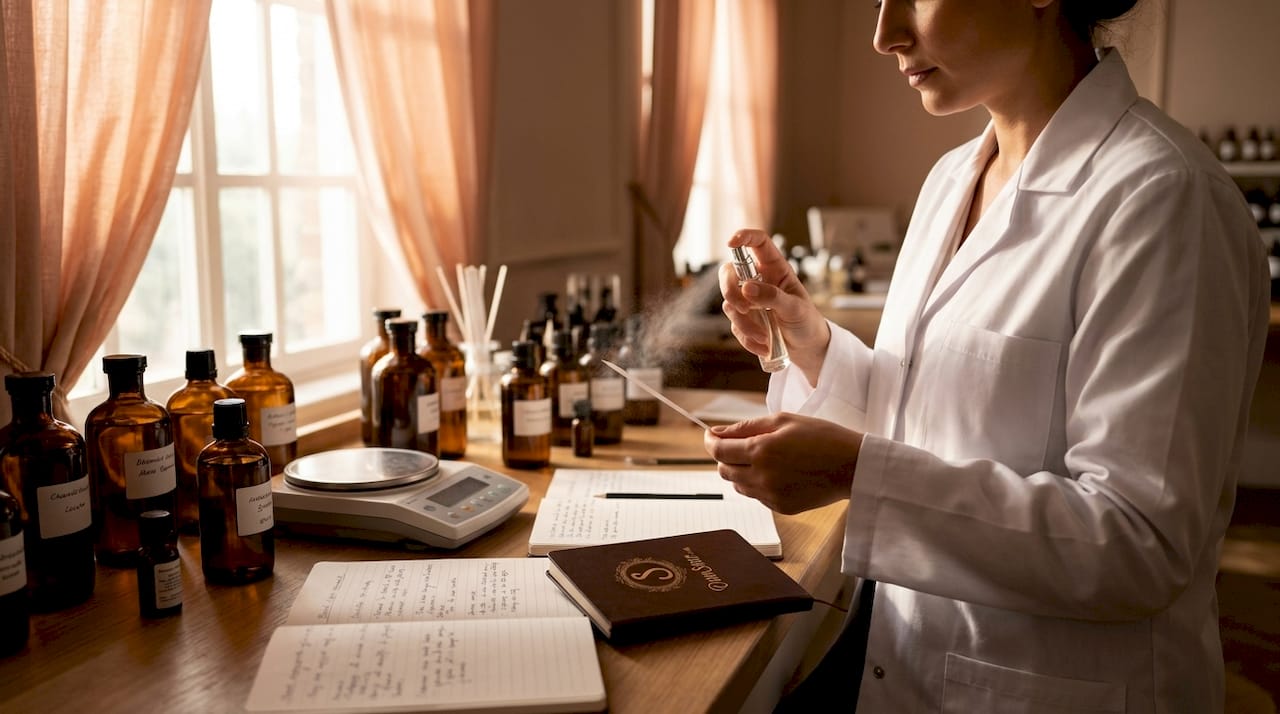
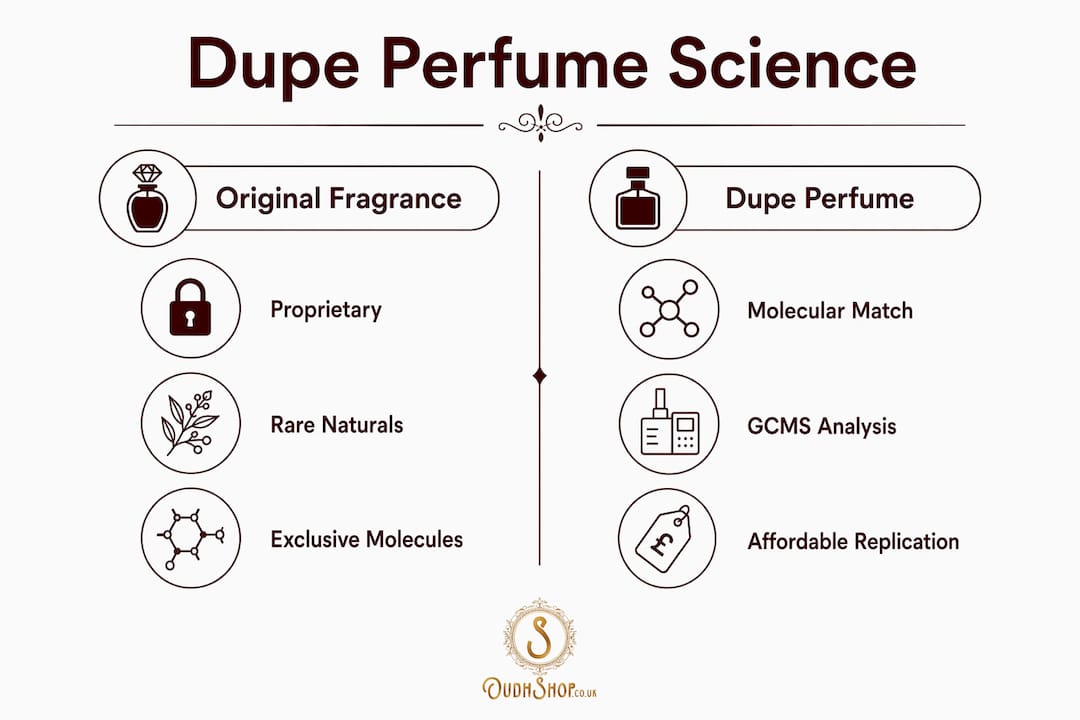
The creation process is far more technical than simply blending similar notes. Perfumers creating dupes use gas chromatography–mass spectrometry (GCMS), an analytical chemistry technique that identifies the precise molecular composition of a fragrance. Rather than guessing that a scent contains rose and amber, GCMS reveals the exact aroma molecules present and in what proportions. This allows a dupe creator to target the architecture of a fragrance rather than just its surface notes.
The science of scent replication
Targeting molecular architecture is what separates a convincing dupe from a vague approximation. A luxury fragrance like Baccarat Rouge 540 achieves its distinctive radiant, woody sweetness through a specific interplay of Ambroxan, Safraleine, and methyl cedarwood molecules. A skilled perfumer using GCMS data can identify those key contributors and reconstruct a blend that triggers the same sensory response. The result is not identical, but it can be remarkably close.
That said, exact replication remains elusive. Luxury houses often use proprietary ingredients, rare naturals, or exclusive aroma chemicals that are either unavailable to dupe makers or prohibitively expensive. This is precisely why dupes are approximations rather than copies. The complexity of a fragrance’s base notes, which develop over hours on the skin, is particularly difficult to replicate at a lower price point.
| Factor | Impact on dupe quality |
|---|---|
| GCMS accuracy | Higher accuracy produces closer molecular match to original |
| Ingredient availability | Rare or proprietary materials limit exact replication |
| Skin chemistry | Personal biology alters how any fragrance develops and projects |
| Concentration level | Eau de Parfum vs Extrait de Parfum affects longevity and sillage |
Pro Tip: Test a dupe on your skin for at least two hours before judging it. The top notes of any fragrance, dupe or original, are the most volatile and least representative of the full scent experience. The heart and base notes tell the real story.
How do dupes differ from knock-offs, clones, and inspired fragrances?
The dupe versus knock-off distinction is the single most important thing to understand before you buy. Consumers who conflate the two risk purchasing fakes that misrepresent themselves as originals, which is both a legal issue and a quality risk.
Here is how the main categories break down:
- Dupe (inspired-by fragrance): Openly marketed as an alternative to a named luxury scent. The brand makes no claim to be the original. Legal, transparent, and increasingly mainstream.
- Clone: A fragrance that replicates a scent very closely, sometimes without explicitly naming the original. Clones occupy a grey area depending on how they are marketed.
- Knock-off or counterfeit: A product that misrepresents itself as the original brand, using copied packaging, logos, or bottle designs. Illegal in most markets and often made with inferior or unsafe ingredients.
- Flanker or flanker-inspired: A fragrance from a legitimate house that riffs on one of its own successful scents. Not a dupe at all, but sometimes confused with one.
The phrase “inspired by” on a label is your clearest legal and ethical signal. It confirms the brand is not claiming to be the original house. Perfumer Victoria Belim-Frolova has noted that some dupes match originals so closely that even trained professionals struggle to distinguish between them in blind tests. That level of closeness is a testament to modern analytical chemistry, but it also raises questions about where inspiration ends and imitation begins.
What are the ethical debates around perfume dupes?
The controversy surrounding dupes is not about legality. It is about artistry and intent. A perfumer who spends years developing a signature accord, layering rare Agarwood with Safraleine and musks to create something genuinely original, reasonably objects when that work is decoded by a machine and sold at a fraction of the price within months of launch.
Victoria Belim-Frolova has argued that using GCMS to copy another’s work crosses a line from inspiration to exploitation, stripping the creative act of its artistic value. This perspective carries weight. Perfumery is one of the few art forms where intellectual property protection is limited. You cannot copyright a scent, which means the only protection a perfumer has is the prestige of their name and the inaccessibility of their ingredients.
“There is a difference between being inspired by a great work and reverse-engineering it molecule by molecule. One is how art has always evolved. The other is something closer to extraction.”
On the other side of the argument, Sergio Tache of Dossier frames dupes as a democratising force. Affordable scent wardrobes allow consumers who could never spend £200 on a single bottle to explore the full spectrum of fine fragrance. Younger buyers in particular treat dupes as a form of informed consumerism, choosing to spend wisely rather than pay for a prestige label. The debate ultimately reflects a broader tension in luxury markets between exclusivity and accessibility, and neither side is entirely wrong.
How to shop smart for affordable perfume dupes
Buying a dupe well requires a different approach to buying a luxury original. The following steps will help you maximise satisfaction and avoid disappointment.
- Look for “inspired by” labelling. This phrase confirms the product is a legitimate dupe rather than a counterfeit. If a listing claims to be Chanel No. 5 at £15, it is a fake. If it says “inspired by Chanel No. 5,” it is a dupe.
- Start with a sample or tester. Many reputable retailers, including Oudhshop, offer perfume testers so you can evaluate a scent before committing to a full bottle. This is the single most effective way to avoid buyer’s remorse.
- Check the concentration. A dupe sold as Eau de Toilette will perform differently to the original Extrait de Parfum it references. Longevity and sillage will vary, sometimes significantly. Always compare like for like where possible.
- Read the return policy. Reputable dupe retailers stand behind their products. A generous return or exchange policy is a strong indicator of quality confidence. Be cautious of sellers with no returns.
- Allow for skin chemistry variation. Personal skin chemistry alters how any fragrance develops and projects on your body. A dupe that smells extraordinary on one person may read differently on another. This is not a flaw in the product; it is the nature of fragrance itself.
- Explore designer-inspired fragrances from curated sources. Specialist retailers who focus on inspired-by scents tend to offer better quality control than generic marketplaces.
Pro Tip: When comparing a dupe to its reference scent, spray both on separate wrists at the same time and evaluate them at the 30-minute, two-hour, and four-hour marks. This structured approach reveals how closely the dupe tracks the original across all three fragrance stages.
For a deeper look at how to evaluate scents side by side, Oudhshop’s scent comparison guide offers a practical framework that works equally well for dupes and originals.
Key takeaways
A dupe perfume is a legitimate, openly marketed alternative to a luxury fragrance, distinguished from counterfeits by its honest “inspired by” branding and produced using advanced analytical chemistry to approximate the original’s molecular architecture.
| Point | Details |
|---|---|
| Definition clarity | A dupe is an “inspired by” fragrance, not a fake. Honest branding separates it from counterfeits. |
| Science behind dupes | GCMS technology identifies aroma molecules, enabling close scent replication without exact copying. |
| Price advantage | Dupes can cost up to 77% less than originals, making luxury scent profiles accessible to more buyers. |
| Ethical nuance | Some perfumers view GCMS-based copying as exploitation of creative work, not mere inspiration. |
| Smart buying | Always test via samples, check concentration levels, and buy from retailers with clear return policies. |
My honest view on dupes after years in fragrance
I have spent years exploring both ends of the fragrance spectrum, from rare oud attars and Extrait de Parfum from storied Middle Eastern houses to affordable inspired-by alternatives. My view is that the dupe conversation is often framed too simply as “good value versus artistic theft,” when the reality is considerably more textured.
The best dupes I have encountered do something genuinely useful. They give you access to a scent family, a mood, a style of composition, that you might never have discovered if the price of entry were £200. For someone new to fragrance, a well-made dupe of a smoky, resinous oud accord can open a door to an entirely new world of scent appreciation. That has real value.
Where I part ways with the dupe-first mindset is on longevity and depth. The finest luxury fragrances, particularly those built around genuine Agarwood or rare musks, carry a complexity in their base notes that no GCMS scan fully captures. The dry-down of a true oud perfume, that slow, warm, almost meditative evolution over eight to ten hours, is something that inspired-by versions approximate but rarely replicate. If you fall in love with a dupe, treat it as a starting point rather than a destination. It may lead you to the original, or it may lead you somewhere even more interesting.
The fragrance community has largely made peace with dupes, and rightly so. They serve a genuine purpose. But the most rewarding scent journeys I have witnessed always end with someone discovering a fragrance that is entirely their own, not a copy of someone else’s signature.
— Oudh
Discover your signature scent at Oudhshop
At Oudhshop, we believe that extraordinary fragrance should never be out of reach. Our collection spans authentic oud perfumes, rich Arabian musks, and a carefully curated range of designer-inspired perfume oils that offer genuine quality at accessible prices. Whether you are searching for your first inspired-by scent or looking to expand a serious fragrance wardrobe, our perfume finder helps you match your preferences to the perfect scent profile. For those who prefer to sample before committing, our travel-size perfumes let you explore the full depth of our range without the risk of a full-bottle purchase. Your signature scent is waiting.
FAQ
What is a dupe perfume in simple terms?
A dupe perfume is a fragrance sold as “inspired by” a luxury scent, designed to closely resemble it at a fraction of the price. It is a legitimate product, not a fake or counterfeit.
Are perfume dupes legal to buy and sell?
Yes. Dupes are legal because they are sold under their own branding and do not claim to be the original product. The key distinction is honest “inspired by” marketing versus counterfeit packaging that misrepresents the product as an original.
How close do dupes smell to the original fragrance?
Quality dupes can be remarkably close, with some professionals struggling to distinguish them in blind tests. However, skin chemistry variations and ingredient differences mean longevity and projection may still differ from the original.
What is the difference between a dupe and a knock-off perfume?
A dupe openly markets itself as an alternative using “inspired by” language, while a knock-off misrepresents itself as the original brand. Knock-offs are illegal and often made with inferior or unsafe ingredients.
How do I find the best affordable perfume dupes?
Look for retailers who specialise in inspired-by fragrances, offer tester options, and provide clear return policies. Testing on your skin before purchasing a full bottle is always the most reliable approach.