Luxury Arabian Oud Perfume Blog: Your Guide to Exquisite Fragrances
The role of fragrance in culture: a global guide
TL;DR:
- Fragrance functions as a cultural technology, serving as medicine, ritual, and social signal throughout history.
- Ancient and modern societies have used scent to shape identity, evoke memory, and foster community bonds beyond aesthetics.
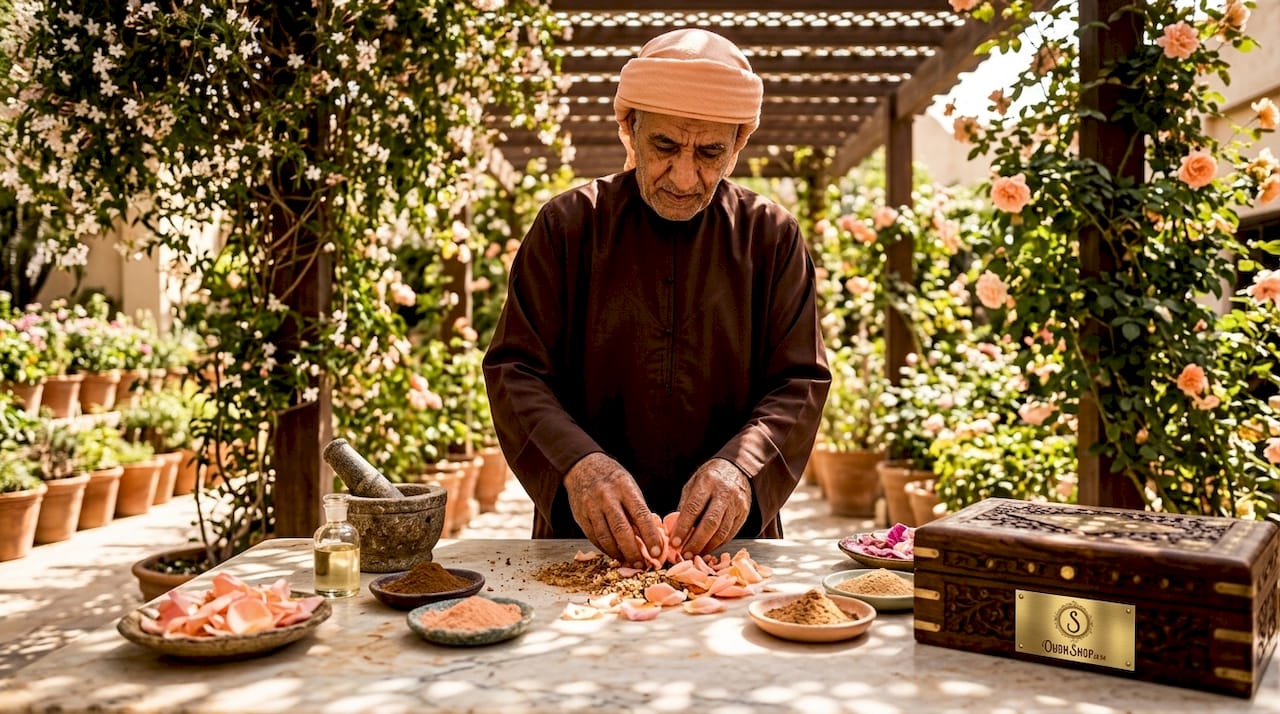
Fragrance is not merely something you wear. Across civilisations, the role of fragrance in culture has been that of healer, guardian, offering, and social currency. Long before the modern perfumery industry gave us Extrait de Parfum and sillage ratings, human societies were burning resins at temple altars, prescribing aromatic herbs for emotional regulation, and pressing scented oils into the hair of the deceased. This article traces the extraordinary scope of that history, from Ayurvedic India to ancient Egypt, Roman household shrines to the perfume souks of the Gulf, revealing how scent has shaped identity, ritual, and belonging for thousands of years.
Key takeaways
| Point | Details |
|---|---|
| Scent as lived technology | Fragrance functions as medicine, ritual tool, and social signal, not merely as decoration. |
| Ancient Egyptian olfactory heritage | Biomolecular archaeology now reconstructs ancient scents for museums, connecting visitors to burial and ceremonial practices. |
| Roman domestic cult and incense | Incense burners found in Pompeii reveal scent’s central role in household worship and protection rituals. |
| Gulf fragrance as identity | In modern Saudi Arabia, oud perfumes carry cultural memory and define personal and social identity. |
| Scent bridges memory and community | Across all cultures, fragrance evokes emotional bonds that neither text nor image can fully replicate. |
The role of fragrance in culture: India’s living tradition
Nowhere is the cultural significance of scents more deeply embodied than in India. Here, fragrance has never been separable from medicine, ritual, or philosophy. The Ayurvedic tradition treats aromatic substances as functional technologies: specific resins, flowers, and woods are prescribed not to smell pleasant, but to balance the doshas, calm grief, and prepare the mind for meditation.
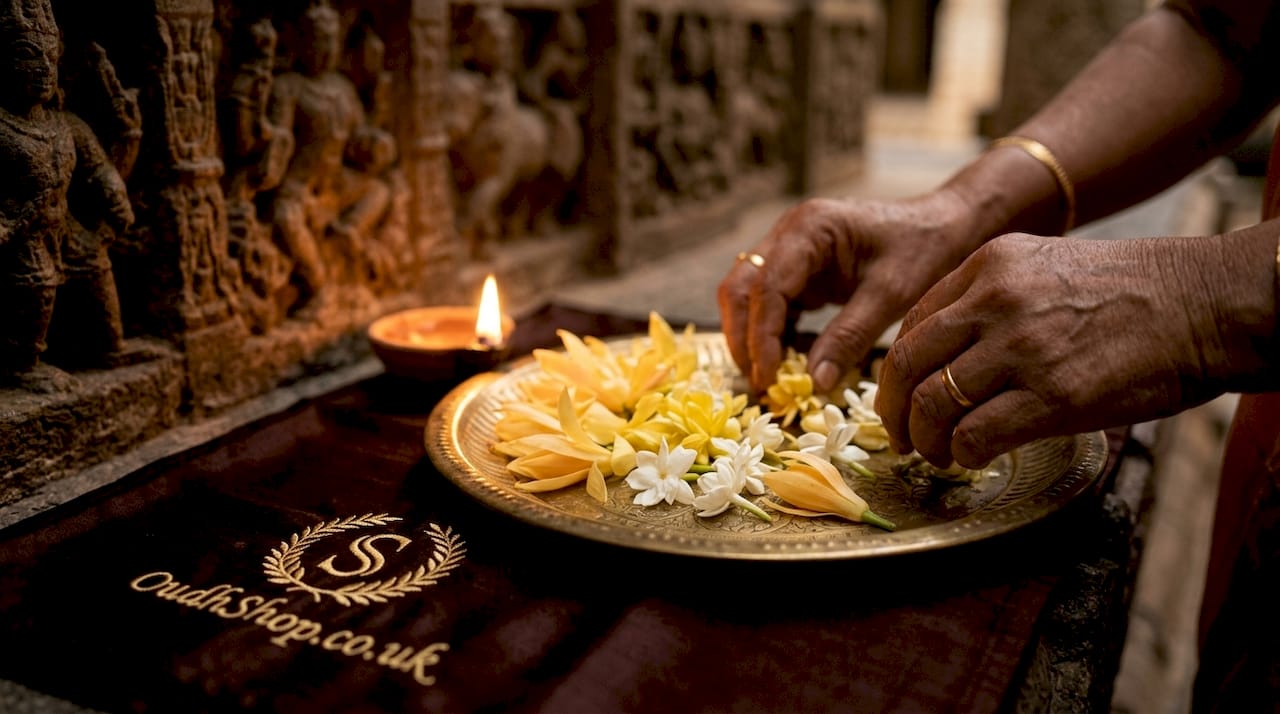
According to classical Sanskrit texts, including the Bṛhat Saṃhitā, fragrance formulation was serious science, treated with the same rigour as astronomy or architecture. This is a profound distinction. Indian fragrance knowledge combines chemistry, ritual, medicine, and emotional regulation, making cultural meaning inseparable from practice. The fragrant smoke rising from a temple’s dhoop stick was never incidental. It was a precise invocation.
The impact of scents on traditions becomes most visible in the context of temple worship. Flowers such as champak and jasmine are offered to deities because their aromatic profiles are understood to attract divine presence. In royal court culture, perfumers held elevated status, crafting bespoke attars for maharajas using techniques passed down through guilds over centuries. The word attar itself, derived from the Arabic ‘itr, signals the ancient cross-cultural exchange that shaped the history of perfume in cultures across South Asia and the Middle East.
Colonial disruption erased much of this vocabulary. The British administration’s preference for standardised trade goods marginalised indigenous aromatic knowledge, replacing it with synthetic alternatives and imported cosmetic frameworks. Today, scholars and practitioners are reclaiming this heritage under the JWALE concept, an effort to reassert indigenous fragrance terminology and practices as legitimate scientific and cultural disciplines.
Pro Tip: If you want to understand Indian fragrance culture beyond the surface, look for traditional attars rather than modern eau de parfums. The hydro-distilled process used in attar production preserves aromatic molecules that synthetic compositions simply cannot replicate.
Key dimensions of fragrance in Indian culture include:
- Healing: Aromatic substances used in Ayurvedic medicine to treat psychological and physical conditions
- Devotion: Specific flowers and resins associated with particular deities and used in daily puja
- Social hierarchy: Bespoke perfumes as markers of royal and priestly status
- Preservation: Ongoing efforts to document and revive classical fragrance vocabularies lost under colonialism
Ancient Egypt: recreating sacred scents
Few civilisations understood the power of fragrance and social rituals as acutely as ancient Egypt. Scent was not decorative. It was theological. The gods were believed to smell of kyphi, a complex resinous compound burnt at sunset in temples across the Nile Valley, and the preservation of the dead was as much an olfactory act as a physical one.
Recent advances in biomolecular archaeology have made it possible to reconstruct the actual scent of mummification balms. By analysing organic residues on preserved linen and canopic vessels, scientists identified aromatic compounds including plant-based resins, animal fats, and beeswax. These findings formed the basis for museum scent reproductions, allowing visitors to encounter an olfactory experience that no text or visual exhibit could provide.
“Scent evokes atmospheres and moods inaccessible through visuals or text alone, acting as a cultural bridge.” — Frontiers in Environmental Archaeology
This field, known as olfactory museology, deploys both scented cards and fixed diffusion stations within gallery spaces. The goal is not novelty. It is emotional and intellectual depth. When a museum visitor smells a reconstruction of a 3,500-year-old burial balm, they encounter ancient ritual through the oldest sensory pathway humans possess. Olfactory heritage reconstructions are interpretations that balance molecular evidence with cultural storytelling, shaped by curatorial choices about which aspects of a civilisation deserve to be foregrounded.
Pro Tip: When visiting exhibitions with scent stations, take your time. The olfactory system processes scent directly through the limbic system, meaning emotional responses arrive before conscious analysis. That initial reaction is your most authentic encounter with the ancient world.
The ethical dimensions here are worth considering. Reconstructed scents are interpretations, not facsimiles. A museum’s curatorial team decides which molecules to emphasise and which cultural narratives to centre. Museum scent exhibits also carry genuine accessibility benefits, allowing visitors with visual impairments to engage with heritage on equal terms.
Roman household shrines and the incense economy
The fragrant life of ancient Rome was not confined to public temples and imperial processions. It lived quietly in the home. In the lararium, a small household shrine found in virtually every Roman dwelling, families made daily offerings to the Lares and Penates, the protective spirits of the household and storeroom.
Archaeological excavations at Pompeii have recovered incense burners directly linked to these domestic cult practices. Organic residue analyses of these vessels identify the precise substances burned, including resins, aromatic woods, and grain offerings. The act of burning incense was not occasional. It was a daily governance practice, a ritual by which a Roman family maintained its relationship with the divine forces that protected them.
| Ritual context | Fragrant substance | Purpose |
|---|---|---|
| Household shrine (lararium) | Resin and grain offerings | Honour Lares and Penates, attract protection |
| Funerary rites | Aromatic woods and myrrh | Accompany the deceased to the afterlife |
| Public temple sacrifice | Incense and wine | Propitiate gods in civic ceremony |
| Imperial court | Rare Eastern resins | Display power and divine favour |
The ritual instruments in domestic spaces found at Pompeii also reveal something about Roman economic life. The spice and resin trade that supplied Roman households stretched from Arabia Felix to India and sub-Saharan Africa. A pinch of frankincense burned before a Pompeian household altar represented an extraordinary global supply chain. Scent, here, was simultaneously spiritual practice and geopolitical statement.
Roman funerary customs further illustrate the role of scent in spirituality. Bodies were anointed with precious oils, pyres were built from aromatic cedar, and mourners wore garlands of fragrant flowers. The boundary between the living and the dead was, in Roman understanding, olfactory as much as physical.
Gulf fragrance culture: identity and hospitality
In the contemporary Gulf region, particularly across Saudi Arabia, the UAE, and Kuwait, fragrance remains one of the most eloquent languages of social life. The role of oud, the resinous heartwood of the Aquilaria tree and arguably the most prized aromatic material on earth, goes far beyond personal preference.
Fragrance in Jeddah remains tied to hospitality, gifting etiquette, and identity, blending modern mall culture with centuries-old tradition. When a guest is welcomed into a Saudi home, they are typically offered bakhoor, a blend of oud chips and aromatic resins burned on charcoal, before any food or conversation. This is not decoration. It is a formal declaration of respect and welcome. Refusing or ignoring it would be a social miscalculation.
The cultural significance of oud as liquid gold is carried through how fragrance affects identity in Gulf societies. A man’s choice of oud speaks to his tribe, his taste, and his generation. Older generations favour heavy, resinous compositions with deep barnyard and woody base notes. Younger consumers, shaped by global travel and social media, are shifting towards lighter floral and citrus-oud hybrids without abandoning the cultural core of the tradition.
Fragrance gifting in this context is governed by its own detailed etiquette:
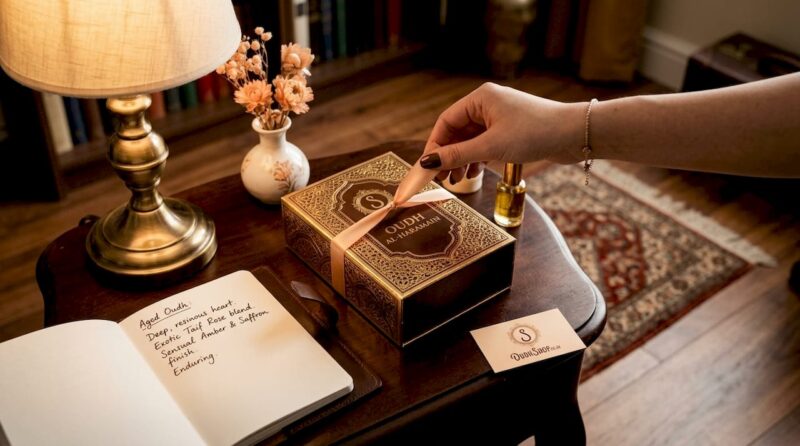
- Oud gift sets are considered appropriate for weddings, Eid, and significant business relationships
- Presentation matters as much as the scent: ornate bottles and decorated packaging carry social weight
- Doubling a scent (giving someone a fragrance they already own or wear) is seen as a compliment, not an oversight
- Personalisation through bespoke blending is the ultimate gesture, reserved for the most significant relationships
The modern Gulf perfume market shows a dynamic fusion of tradition and youthful innovation, where heritage and modernity coexist within the same bottle.
Scent, memory, and shared humanity
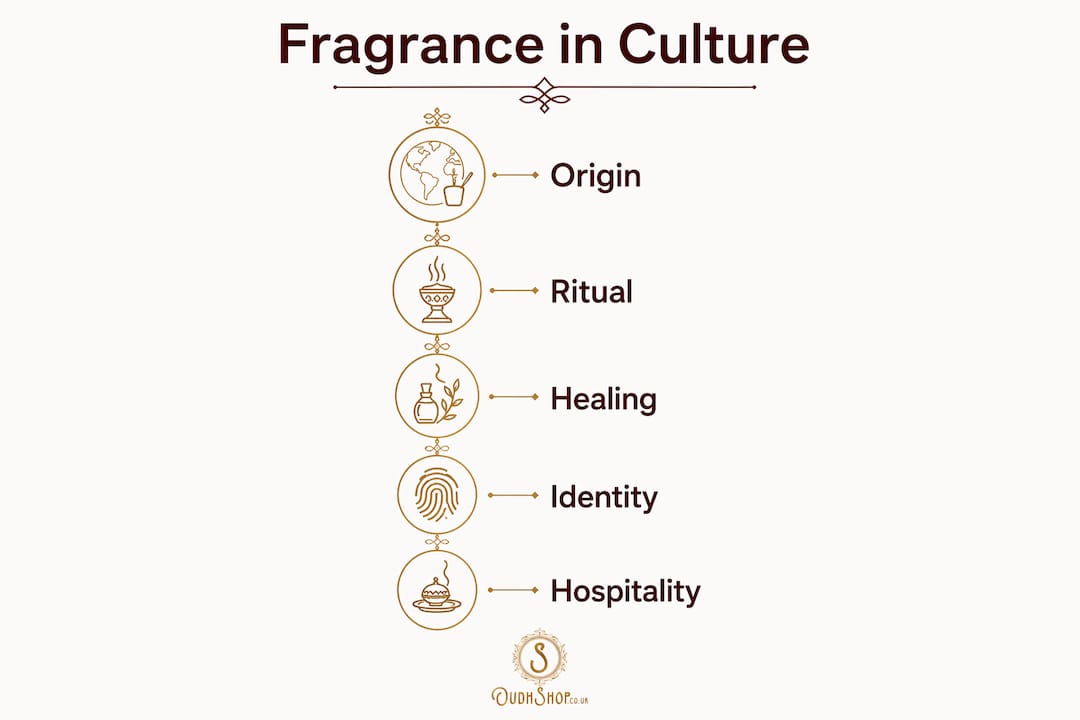
Pull back from any single tradition and a pattern emerges. Across ancient Egypt, Vedic India, Roman Pompeii, and the contemporary Gulf, scent consistently performs the same profound functions: it marks transitions, builds community, defines belonging, and anchors memory.
The neuroscience behind this is striking. The olfactory system is the only sensory pathway that connects directly to the hippocampus and amygdala, the regions governing memory and emotion. This is why a particular fragrance can return you instantly to a specific room in your childhood home. Cultures across time have intuitively understood this, which is why fragrance and cultural ceremonies remain inseparable worldwide.
| Culture | Primary role of scent | Key aromatic material |
|---|---|---|
| Ancient Egypt | Ritual and funerary | Kyphi, myrrh, beeswax |
| Vedic India | Healing and devotion | Sandalwood, champak, jasmine |
| Ancient Rome | Domestic protection and funerary | Frankincense, cedar, grain resins |
| Modern Gulf | Identity and hospitality | Oud (Agarwood), bakhoor, musk |
Fragrance is also a marker of identity and well-being across diverse cultural contexts, and that function has not diminished in the modern age. If anything, it has intensified. As global cultures become more visually homogenised through digital media, scent remains one of the last genuinely personal and culturally specific expressions of selfhood.
My perspective: fragrance is a civilisational technology
I have spent years studying and sourcing fragrances that carry genuine cultural weight, and the single most persistent misconception I encounter is the idea that perfume is decoration. Something you add after everything else is in place.
What I have found, in every tradition from the Persian attar guilds to the gangajal offerings of Indian temples, is that fragrance precedes decoration. It is the structure within which ritual becomes meaningful. When Roman families burned resin at their household shrines each morning, they were not adding ambience. They were performing the act that constituted their relationship with the divine.
The scholarship emerging from olfactory museology, Ayurvedic fragrance studies, and archaeochemistry is confirming what these traditions always knew: scent is a technology of the highest order, capable of transmitting cultural memory across millennia. A reconstructed Egyptian mummification balm in a museum gallery is not a gimmick. It is the past speaking in its own language.
My view is that most of us in the modern West have impoverished our relationship with scent by reducing it to a finishing touch. The richer way to engage with fragrance, and one that every tradition covered here demonstrates, is to understand it as an active participant in how we live, worship, grieve, celebrate, and remember.
— Oudh
Explore fragrance heritage at Oudhshop
At Oudhshop, every fragrance in our collection carries a story rooted in the same cultural traditions explored above. Our oud and musk perfumes are sourced with genuine attention to provenance and aromatic integrity, from the smoky, resinous depth of pure Agarwood Extrait de Parfum to the sensual warmth of velvety musk compositions that honour classical Arabian perfumery. Whether you are searching for a meaningful gift or a signature scent that speaks to your own cultural identity, our perfume gift sets offer beautifully presented collections suited to every significant occasion. For those new to this world, our perfume finder guides you through your preferences with the expertise of seasoned perfumists.
FAQ
What is the role of fragrance in culture?
Fragrance serves as a ritual tool, social signal, healing substance, and identity marker across cultures worldwide. Its cultural functions extend far beyond aesthetics, encompassing spiritual practice, community belonging, and the preservation of collective memory.
How does oud feature in Gulf cultural traditions?
Oud, derived from the resinous Agarwood tree, is central to Gulf hospitality and gifting rituals. Burning bakhoor to welcome guests and presenting oud-based gifts at weddings and Eid are deeply embedded social fragrance rituals that carry profound social meaning.
Can ancient scents really be reconstructed?
Yes, through biomolecular archaeology, scientists analyse organic residues from ancient artefacts to identify aromatic compounds. These reconstructed ancient scents are interpretations shaped by scientific evidence and curatorial decisions, not exact replicas.
How did ancient Rome use fragrance in the home?
Roman households burned incense daily at lararia shrines as offerings to the Lares and Penates. Organic residue analyses of Pompeii’s incense burners confirm these were structured daily rituals, not occasional ceremonies.
Why does scent evoke such strong memories?
The olfactory system connects directly to the hippocampus and amygdala, bypassing the analytical brain. This direct pathway explains why scent triggers emotional memory responses more vividly and immediately than any other sense.