Luxury Arabian Oud Perfume Blog: Your Guide to Exquisite Fragrances
Discover the differences between perfume types for scent lovers
TL;DR:
- Understanding perfume concentrations helps UK fragrance lovers select scents that match their desired longevity and intensity. Higher concentration fragrances like EDPs and attars offer longer-lasting, more intimate scents, while lighter options like EDTs and EDCs suit casual or warmer weather wear. Skin chemistry, climate, and application technique significantly influence how any fragrance performs throughout the day.
Standing in front of a fragrance counter, or scrolling through an online boutique, you have almost certainly encountered a bewildering array of labels: Eau de Toilette, Eau de Parfum, Extrait de Parfum, attar. For UK fragrance lovers drawn to the opulent world of luxury and Arabian scents, these terms can feel more like a riddle than a guide. Yet understanding what each label truly means is the single most powerful tool you can possess when building a signature scent wardrobe. This guide cuts through the confusion, explains the real differences, and gives you the confidence to choose with precision and pleasure.
Table of Contents
- Perfume types explained: from EDC to attar
- How fragrance concentration influences strength and longevity
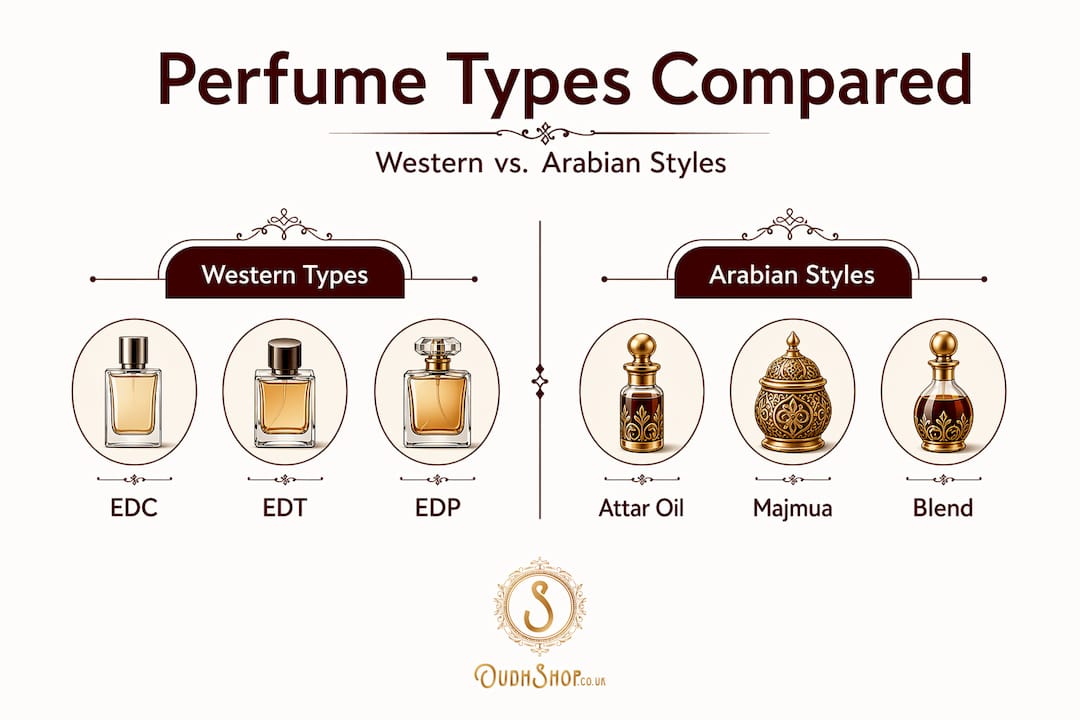
- Regional style and Arabian perfume traditions
- Pitfalls and myths: why not all labels are reliable
- Choosing the right perfume for your needs
- Our take: what really matters when picking perfume types
- Discover your perfect scent with Oudh Shop
- Frequently asked questions
Key Takeaways
| Point | Details |
|---|---|
| Concentration sets the basics | Perfume types mainly differ by fragrance oil percentage, affecting scent strength and longevity. |
| Label flexibility matters | Brand and market differences mean ‘EDP’ or ‘EDT’ are guides, not rules—always try before you buy. |
| Oil versus alcohol | Arabian oils (attars) provide lasting close-to-skin scent, while sprays offer more immediate projection. |
| Performance is personal | How a perfume wears depends on your skin, climate, and how you apply and layer your fragrances. |
| Smart scent decisions | Combine label info with practical testing and tools to find your ideal perfume match. |
Perfume types explained: from EDC to attar
At the heart of every perfume classification lies one fundamental principle: the concentration of fragrance oils dissolved in a carrier, typically alcohol or a neutral oil. As our perfume types guide explains, fragrance types like EDC, EDT, EDP, and Parfum are primarily differentiated by this fragrance-oil concentration. Everything else, from the bottle design to the marketing language, is secondary.
Here is a clear breakdown of the major perfume types you will encounter:
- Eau de Cologne (EDC): The lightest of the alcohol-based categories, typically containing 2–5% fragrance oil. Fresh, citrus-forward, and ideal for a quick burst of scent. Wear time is usually one to two hours.
- Eau de Toilette (EDT): A step up in concentration, usually 5–15%. The EDT is perhaps the most popular format in Western markets, offering a balanced projection that suits daytime and office wear beautifully.
- Eau de Parfum (EDP): Richer and more enduring, with concentrations typically between 15–20%. An EDP offers deeper base notes and a more pronounced sillage (the scent trail you leave behind).
- Parfum or Extrait de Parfum: The most concentrated alcohol-based format, usually 20–40% fragrance oil. Exquisite and long-lasting, often the preserve of niche and luxury houses.
- Attar or Oud oil: Pure oil-based fragrances with no alcohol. Concentration can be extraordinarily high, sometimes near 100% pure aromatic material. These are the jewels of Arabian perfumery, prized for their intimate, skin-close warmth and extraordinary longevity.
It is worth noting that these percentages are typical, not universal. A brand may label something an EDP at 12% or an EDT at 18%. Regional conventions and house preferences play a significant role, which we will address shortly.
| Perfume type | Typical oil concentration | Expected wear time |
|---|---|---|
| Eau de Cologne (EDC) | 2–5% | 1–2 hours |
| Eau de Toilette (EDT) | 5–15% | 2–4 hours |
| Eau de Parfum (EDP) | 15–20% | 4–8 hours |
| Parfum / Extrait | 20–40% | 6–12+ hours |
| Attar / Oud oil | Up to near 100% | 8–24+ hours |
How fragrance concentration influences strength and longevity
Now that you know how perfumes are classified, let us see how these types perform in real life. Higher concentration generally increases longevity and sillage, but the exact experience is also shaped by the composition and volatility of individual aroma materials. In other words, concentration is a strong indicator, not an absolute guarantee.
Consider a vibrant citrus EDT versus a resinous oud EDP. The citrus EDT may feel bold and immediate, but those top notes evaporate quickly because citrus molecules are highly volatile. The oud EDP, built on dense, woody base notes, may open quietly but deepen and expand across an entire day. The type of ingredients matters as much as the percentage.
Several real-world factors alter how a fragrance wears on your skin:
- Skin chemistry: Dry skin tends to absorb and dissipate fragrance faster than oily skin. If your skin is naturally dry, you may find that even a strong EDP fades within a few hours.
- Climate and temperature: Warmer temperatures accelerate the diffusion of fragrance molecules, amplifying projection. In the cool, damp British climate, scents often perform more quietly than they would in the Middle East or Mediterranean.
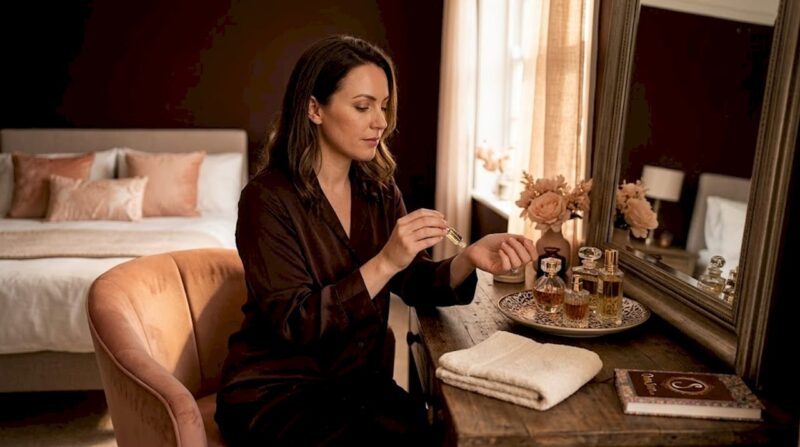
- Application method: Spraying on pulse points (wrists, neck, inner elbows) maximises warmth-driven diffusion. Dabbing oil-based attars directly onto the skin encourages a slow, intimate bloom.
- Layering: Applying an unscented moisturiser or a complementary body oil before your fragrance creates a hydrated base that holds scent molecules for longer. Our scent layering tips explore this technique in detail.
- Clothing versus skin: Fabric retains fragrance for a remarkably long time. Spraying lightly on the inner hem of a garment can keep a scent alive well beyond what skin alone would sustain.
For a practical reference, this fragrance concentration cheat sheet offers a useful visual summary of how these variables interact.
“Sillage is not simply about strength. It is the art of leaving the right impression in every room you enter.”
Pro Tip: In winter, opt for richer EDPs or attars and apply to warm pulse points. In summer, a well-chosen EDT or even an EDC can feel refreshingly appropriate without overwhelming those around you. Revisit your application tips for longevity each season to keep your fragrance wardrobe performing at its best.
Regional style and Arabian perfume traditions
Western and Arabian perfume traditions further shape how these types are experienced and marketed. In the UK and across Europe, alcohol-based sprays dominate the market. They project boldly, dry down quickly, and suit the fast-paced nature of modern Western life. Arabian perfumery, by contrast, has centuries of devotion to oil-based attars and concentrated resinous blends, a tradition rooted in the cultural and spiritual significance of scent.
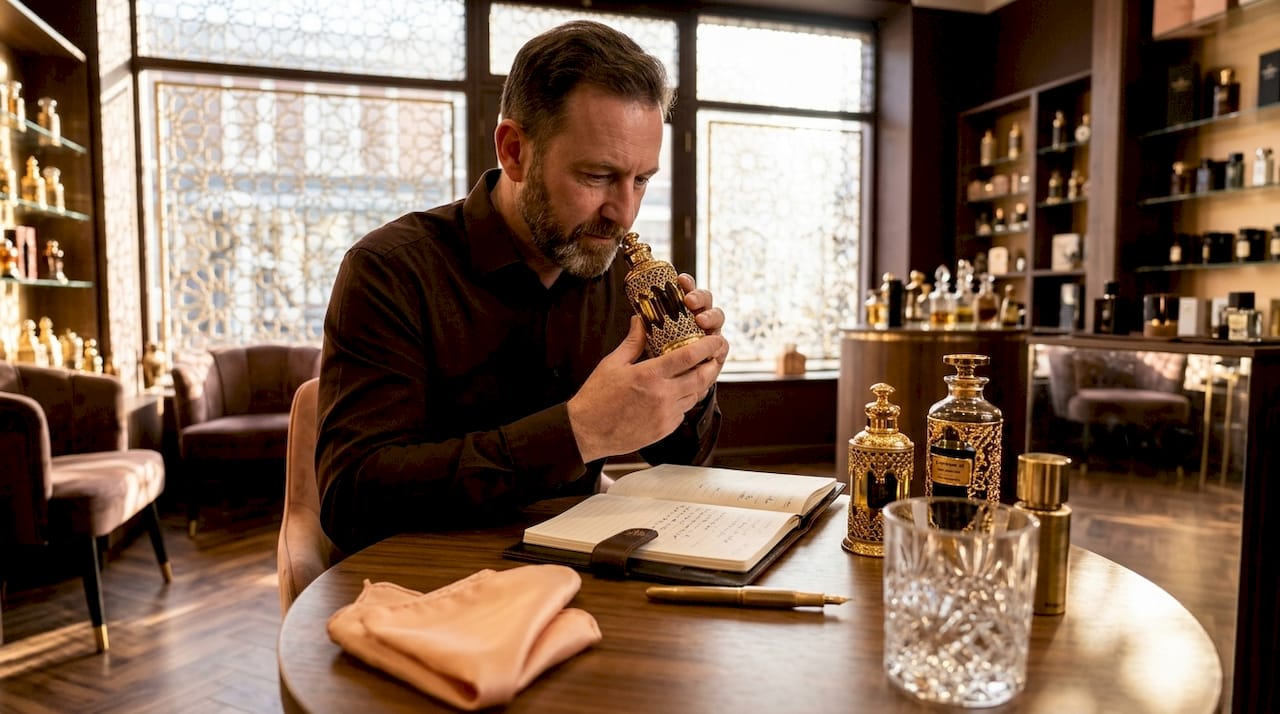
Oil-based formulations may project less at first but can remain detectable on the skin far longer than alcohol-based ones. This is because oil molecules bind more intimately with the skin’s surface, releasing slowly and continuously rather than evaporating in a dramatic opening burst. For those who love the idea of a scent that becomes yours, uniquely shaped by your skin chemistry, attar is an incomparable choice.
Here is why attars are prized by discerning fragrance lovers:
- Depth and complexity: Attars, particularly those built around Agarwood (oud), rose, or musk, reveal layers of character across hours of wear. They are not static; they evolve.
- Skin closeness: Because they project softly, attars create an intimate scent bubble rather than a loud sillage. This is considered deeply sophisticated in Arabian culture.
- Longevity: A single application of a quality oud attar can last through an entire day and into the evening, even beyond 24 hours on fabric.
- Alcohol-free comfort: For those who observe religious practices that discourage alcohol, or those with sensitive skin, oil-based attars offer a spiritually and physically comfortable alternative.
It is also worth noting that many luxury Arabian fragrances labelled as EDP behave more like an Extrait de Parfum due to their exceptionally high oil content and the density of their base materials. Our oud and Arabian perfume guide explores this fascinating intersection of tradition and modern classification.
Pro Tip: For all-day presence with a distinctive character, try layering an attar on your pulse points first, then misting a complementary EDP over the top. The oil anchors the scent to your skin while the spray adds projection and a vivid opening.
Pitfalls and myths: why not all labels are reliable
Despite all these helpful guidelines, it is easy to be caught out by misleading or non-standard perfume labelling. Percentage cutoffs for EDP, EDT, and Parfum vary by brand and region, and naming is far from perfectly standardised across the global fragrance industry.
This means that an EDP from one house may actually contain less fragrance oil than an EDT from another. You might purchase what you expect to be a rich, long-lasting scent, only to find it dissipates within a couple of hours. Equally, a modestly labelled EDT from an Arabian house may carry a depth and tenacity that rivals many European Extraits.
Common myths and misconceptions to watch out for:
- Myth: A higher label always means a better scent. An Extrait de Parfum is not inherently superior to an EDT. The best fragrance for you is the one that suits your skin, style, and occasion.
- Myth: EDP always lasts longer than EDT. Composition matters enormously. A musty, resin-heavy EDT can outlast a citrus-forward EDP with ease.
- Myth: Oil-based means old-fashioned. Attars and oud oils represent some of the most sophisticated and sought-after fragrances in the world. They are anything but outdated.
- Myth: The label tells you everything. It tells you something useful, but not the full story. Always test on skin and allow at least 30 minutes for the dry-down before forming a judgement.
Understanding the EDP vs oud differences is particularly valuable when navigating Arabian fragrance collections, where the interplay between format and ingredient intensity can be delightfully surprising.
“Use concentration as a guide, not gospel. Your skin is the final authority.”
For a thorough look at how labels can mislead, this guide to label myths and realities is a worthwhile read.
Choosing the right perfume for your needs
With the facts and pitfalls cleared up, how can you decide which perfume type is truly best for you? The answer lies in a thoughtful, personal assessment rather than a simple rule. As this fragrance concentration guide rightly notes, concentration labels are best used as an expectation-setting tool, since performance depends on your skin, application method, and the volatility of individual molecules.
Follow these steps to make a confident, informed choice:
- Assess your desired intensity. Do you want a whisper of scent for a professional setting, or a bold, memorable presence for an evening event? EDC and EDT suit subtlety; EDP, Extrait, and attar suit impact.
- Consider lasting power. If you dislike reapplying throughout the day, lean towards EDP, Extrait, or attar. If you enjoy the ritual of refreshing your scent, a lighter EDT may suit you perfectly.
- Think about projection. Do you want your scent to announce your arrival, or to be discovered only in close proximity? Alcohol-based formats project more boldly; oils stay close to the skin.
- Factor in the season and climate. British winters call for warming, resinous base notes in concentrated formats. Summers invite lighter, fresher constructions in EDT or even EDC.
- Know your skin type. Oily skin amplifies and holds fragrance naturally. Dry skin benefits from richer concentrations or a moisturising base layer beneath the fragrance.
- Always test before committing. Apply to the wrist, wait 30 minutes, then reassess. Revisit after two hours. A fragrance that dazzles on first spray may disappoint in its dry-down, or vice versa.
Our perfume finder tool can help you navigate options based on your preferences, while our scent notes advice decodes the language of top, heart, and base notes. For a broader overview, our perfume categories explained guide provides further context.
Pro Tip: Test a fragrance on both skin and fabric simultaneously. Note how each evolves across the day. This dual-testing approach reveals the true character of any perfume type far more reliably than a single sniff from the bottle.
Our take: what really matters when picking perfume types
The journey does not end with reading a label, and in our experience, the most rewarding fragrance discoveries happen when you move beyond classification entirely. Labels and concentration percentages are genuinely useful starting points, but they are only the opening chapter of a much richer story.
We have seen countless enthusiasts purchase an Extrait de Parfum expecting an overwhelming, all-day presence, only to find it vanishes on their dry skin within hours. Conversely, a delicate attar applied with a single fingertip can bloom magnificently in warm weather, filling a room with a quiet, resinous grandeur that no spray could replicate. Skin chemistry is, without question, the most underestimated variable in perfumery.
For UK wearers specifically, the temperate and often cool climate creates a unique challenge. Fragrance projection is naturally subdued in cold, damp air. This means that what performs beautifully in a Dubai souk may feel almost invisible on a grey London morning. Our advice is to embrace layering as a practical solution rather than a luxury indulgence. Our expert layering advice offers specific guidance for combining Arabian and Western formats to create a scent that performs brilliantly in any British season.
The most memorable fragrance journeys are built through experimentation, seasonal rotation, and an openness to formats you might not have previously considered. A savvy enthusiast does not simply buy one bottle and call it done. They build a wardrobe of complementary types, reaching for a light EDT on a summer morning and an oud attar on a winter evening. That is where true mastery lies.
Discover your perfect scent with Oudh Shop
Ready to move from understanding to experiencing? At Oudh Shop, we have curated a collection that spans every perfume type discussed in this guide, from vibrant EDTs to exquisitely concentrated attars and luxurious Arabian EDPs that perform like an Extrait.
Whether you are searching for a rich oud oil, an accessible everyday EDP, or a beautifully packaged fragrance gift, our range has been assembled with genuine passion for the art of perfumery. Use our personalised perfume finder to receive tailored recommendations based on your preferred notes, intensity, and occasion. We offer tester sizes for risk-free sampling and fast UK shipping, so you can explore with confidence and discover the format that truly suits your skin and style.
Frequently asked questions
What is the main difference between Eau de Cologne and Eau de Parfum?
Eau de Cologne contains much less fragrance oil (2–5%) and smells lighter and fresher, while Eau de Parfum holds up to 20% oil for a richer, more enduring scent that develops beautifully across the day.
Does higher concentration always mean longer-lasting perfume?
Generally yes, but longevity is also affected by ingredient volatility and composition, meaning some lighter perfumes built on slow-evaporating molecules can outlast heavier concentrations.
Are attars and oils better for sensitive skin?
Attars are alcohol-free and often gentler on the skin, and their oil base and slow release make them a preferred choice for those with sensitivity or those who observe alcohol-free practices.
Can two perfumes with the same label have different strengths?
Yes, because naming conventions vary by brand and market, meaning two EDPs from different houses may have noticeably different oil concentrations and performance characteristics.
Does the way I apply perfume affect how long it lasts?
Absolutely; application method influences performance as significantly as concentration does, with layering, pulse-point placement, and combining oils with sprays all extending how a scent evolves throughout the day.