Luxury Arabian Oud Perfume Blog: Your Guide to Exquisite Fragrances
The role of musk in fragrances: its impact and evolution
TL;DR:
- Musk is the foundational backbone of most perfumes, providing warmth, diffusion, and longevity. Its evolution from natural animal sources to responsible synthetic macrocyclics reflects ethical progress and Olfactory sophistication. Understanding musk’s subtle yet powerful role enables fragrance lovers to appreciate and craft scents that are both beautiful and environmentally conscious.
Musk is one of perfumery’s most misunderstood players. Ask most fragrance lovers to describe it and they might picture something heavy, animalic, even overpowering. The reality is far more nuanced and infinitely more fascinating. Musk is the invisible architecture beneath almost every great scent you have ever worn, quietly shaping how it opens, evolves, and lingers on your skin for hours. Understanding musk properly changes the way you shop for, wear, and appreciate fragrance, and that journey from ancient origins to today’s sophisticated synthetic alternatives is one of the most compelling stories in the world of perfumery.
Table of Contents
- Understanding musk’s essence in perfumery
- The journey from natural to synthetic musk
- Comparing types of synthetic musks
- How musk shapes fragrance character and versatility
- Ethical, environmental, and personal choice: the modern musk dilemma
- Our perspective: reimagining musk’s role for fragrance lovers
- Discover musk-inspired fragrances at Oudh Shop
- Frequently asked questions
Key Takeaways
| Point | Details |
|---|---|
| Musk is a vital fixative | It makes fragrances last longer by slowing evaporation and blending notes smoothly. |
| Transition to synthetics | Animal-derived musks are banned, pushing perfumers towards ethical synthetic alternatives. |
| Synthetic types matter | Macrocyclic musks are safer and more eco-friendly than older, restricted nitro musks. |
| Seasonal musk choices | Opt for white musks in summer and deeper musks in winter for the best scent effect. |
| Ethics and personal preference | Modern perfumery balances sustainability and individuality, letting you choose your ideal musk. |
Understanding musk’s essence in perfumery
At its most fundamental, musk is a category of scent materials that share a warm, sensual, skin-like quality. In traditional perfumery, musk referred specifically to the secretion from the gland of the male musk deer, a substance so powerfully aromatic that tiny quantities could perfume entire rooms. Today, the term covers a broader family of naturals, plant-based sources, and the synthetic molecules that have largely replaced animal-derived musk in contemporary fragrance creation.
The sensory character of musk is deliberately elusive. It is not a note that announces itself boldly the way a rose absolute or a sharp citrus would. Instead, musk operates closer to the threshold of human perception, creating a soft, enveloping warmth that reads almost as a natural extension of your own skin. This is precisely what makes it so seductive. When someone tells you that a fragrance smells like you, but better, musk is almost always the reason.
The most important functional role musk plays is that of a fixative. As musk serves as a fixative, it slows the evaporation of volatile top and heart notes, extending the life of a fragrance and providing a warm, skin-like sensuality that anchors the entire composition. Without a musk base, many of the bright, sparkling notes you love in the opening of a fragrance would disappear within minutes, leaving nothing behind.
“Musk is the silent architect of perfumery. It does not seek the spotlight, yet without it, the entire structure collapses.”
Understanding musk scent origins helps you appreciate why nearly every professional perfumer, from Grasse to the souks of Arabia, has relied on this ingredient for centuries. It is not simply a note. It is the foundation upon which memorable sillage is built.
Key sensory effects of musk in a fragrance include:
- Warmth: It creates a skin-temperature intimacy that synthetic woody notes cannot replicate.
- Diffusion: It helps a fragrance radiate softly into the air around you rather than sitting flat on your skin.
- Blending: It softens transitions between notes, smoothing out any roughness between your top, heart, and base.
- Longevity: As a fixative, it measurably extends the dry-down phase, which is where a fragrance truly reveals its character.
The journey from natural to synthetic musk
The history of musk in perfumery spans thousands of years. Ancient civilisations, from China and Tibet to Persia and Arabia, prized natural musk as both a perfume ingredient and a medicinal substance. It was genuinely rare, extraordinarily expensive, and deeply connected to luxury. A single musk deer produces only around 25 to 30 grams of secretion per year, which partly explains why genuine natural musk was historically worth several times its weight in gold.
The transition away from animal musk was both ethical and regulatory. Here is how that journey unfolded:
- Pre-20th century: Natural musk deer secretion dominates high-end perfumery. Demand is so high that populations of the Moschus moschiferus deer in the Himalayas and Siberia are severely threatened by overhunting.
- Late 19th century: Synthetic nitro musks are discovered accidentally, offering perfumers an affordable and scalable alternative for the first time. Musk becomes democratised across mass-market perfumery.
- 1979: CITES (the Convention on International Trade in Endangered Species) places strict international protections on the musk deer. Natural deer musk is banned under these protections, and IFRA (the International Fragrance Association) subsequently prohibits its use in commercial fragrances.
- Late 20th century to present: Research into polycyclic and later macrocyclic musks accelerates, with macrocyclics eventually becoming the preferred choice for safety, biodegradability, and olfactory sophistication.
This evolution was not simply a regulatory story. It reflected a genuine shift in the values of the fragrance industry, one that the most discerning fragrance enthusiasts should understand and appreciate.
“The banning of animal musk was not the end of musk in perfumery. It was the beginning of its most creative chapter.”
Pro Tip: When exploring classic musk perfumes, pay attention to how older formulations from the 1970s and 1980s compare to their modern counterparts. The shift in musk chemistry is often audible in the dry-down, even if you cannot name it precisely.
Comparing types of synthetic musks
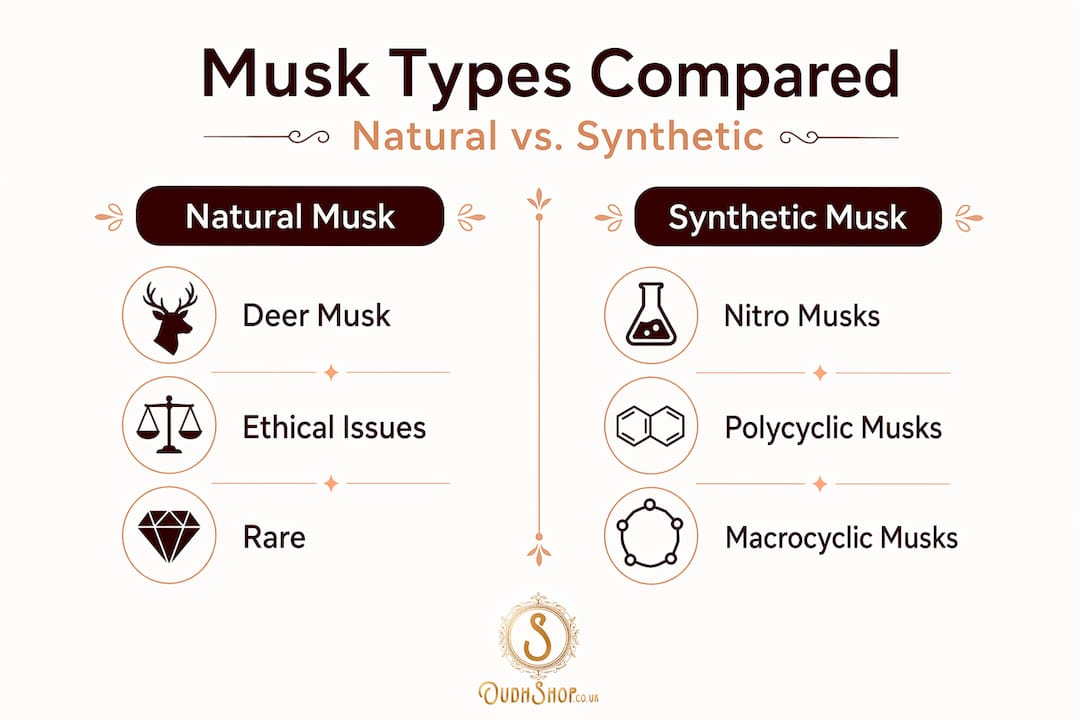
These changes in sourcing have led to a spectrum of synthetic musks, each with distinct properties, regulatory profiles, and olfactory characters.
| Musk type | Examples | Character | Regulatory status |
|---|---|---|---|
| Nitro musks | Musk ketone, musk tibetene | Powdery, warm, strong | Restricted or banned in many applications |
| Polycyclic musks | Galaxolide, Iso E Super | Clean, fresh, synthetic | Some restrictions; under ongoing review |
| Macrocyclic musks | Muscone, ambrettolide | Natural, subtle, skin-like | Preferred; generally regarded as safe |
| Plant-based musks | Ambrette seed, angelica | Animalic depth without animal harm | Widely accepted; growing in popularity |
Synthetic musks encompass nitro types such as musk ketone (now restricted), polycyclic types like galaxolide, and macrocyclic types including muscone and ambrettolide. Macrocyclics are increasingly preferred for their superior biodegradability and cleaner scent profile.

The regulatory picture is particularly important for informed fragrance consumers. Nitro musks like musk ketone carry an IFRA restriction of 1.4% maximum concentration in leave-on products, primarily due to concerns about their environmental persistence. The organisation RIFM (the Research Institute for Fragrance Materials) assesses these compounds against PBT criteria, meaning persistence, bioaccumulation, and toxicity.
Key distinctions between the three main synthetic categories:
- Nitro musks: Potent and once ubiquitous, but many are now restricted or phased out entirely due to concerns about toxicity and their tendency to persist in aquatic environments.
- Polycyclic musks: Widely used in the late 20th century, especially in fabric conditioners and mainstream perfumes. Some are now subject to restrictions after studies revealed environmental persistence.
- Macrocyclic musks: The modern gold standard. They more closely mimic the structure of natural animal musk and break down more readily in the environment. Their olfactory character is also considered more refined and nuanced.
For those seeking long-lasting musk scents, macrocyclic musks offer the most sophisticated and responsible choice, combining genuine longevity with a scent quality that genuinely rewards close attention.
How musk shapes fragrance character and versatility
Understanding the types empowers you to see how musk transforms the experience and versatility of a fragrance, from a summer morning spritz to a winter evening statement.
The concept of musk as a soft focus lens for fragrance is one of the most useful ways to think about its role. Musk provides soft focus blending, smoothing rough edges between notes while imparting a skin-scent effect and encouraging elegant diffusion. White musks in particular are exceptionally versatile in summer, while deeper, richer musks find their fullest expression in the cooler months.
| Season | Musk type to seek | Pairing suggestions | Effect |
|---|---|---|---|
| Spring/Summer | White musk, clean musk | Citrus, green tea, aquatic | Light, fresh, barely-there intimacy |
| Autumn/Winter | Animalic, deep, smoky musk | Oud, amber, resins, spices | Warm, enveloping, sensual depth |
| Year-round | Macrocyclic musk | Floral, woody, oriental | Balanced, sophisticated, adaptable |
Musk’s versatility as a layering component is genuinely underrated, even among enthusiasts who already appreciate complex fragrances. Consider these combinations:
- Musk with oud: Oud’s smoky, resinous depth is amplified and softened simultaneously by a musk base. The musk ensures the composition stays close to skin rather than projecting too aggressively.
- Musk with florals: Rose, jasmine, and ylang-ylang all acquire a more intimate, bodily quality when musk underpins them, evoking the sense of warm skin rather than a vase of cut flowers.
- Musk with citrus: Bergamot and neroli are naturally fleeting. A musk base note extends their freshness into the dry-down, creating a clean, modern sillage that lasts through a full working day.
Pro Tip: To experience musk’s transformative effect, try applying one of the top musk perfumes to your wrist, then warm it gently with your hand and inhale. The shift in intensity and warmth you notice is musk becoming one with your natural skin chemistry, something no other fragrance ingredient replicates quite so intimately.
For those interested in luxury musk perfumes, the finest compositions leverage macrocyclic musks in their Extrait de Parfum concentration, allowing the ingredient to reveal its full complexity across a wear of eight hours or more.
Ethical, environmental, and personal choice: the modern musk dilemma
Bringing together the technical and sensory aspects, it is worth examining what these mean for the ethical and environmental choices you make as a fragrance enthusiast in 2026.
The story of musk’s evolution is, at its heart, a story about the fragrance industry confronting uncomfortable truths. The bans that drove the transition to synthetic alternatives were not simply bureaucratic decisions. They reflected a recognition that the demand for natural musk was contributing to the genuine endangerment of a species. Natural musk transitioned to synthetics due to ethical bans, with modern perfumery now favouring biodegradable macrocyclics over persistent nitro and polycyclic types for genuine sustainability reasons.
The contrast between older and newer synthetic approaches is significant. Older nitro musks were potent but carried real toxic and environmental risks, while newer macrocyclics are safer and ethically sound, though some enthusiasts still seek animalic depth through plant-based sources such as ambrette seed.
Consider the options available to the thoughtful fragrance consumer today:
- Macrocyclic musks: The responsible choice for those who want authentic musk character without environmental compromise.
- Plant-based alternatives: Ambrette seed oil and angelica root offer genuine animalic warmth derived entirely from botanical sources, beloved by natural perfumery enthusiasts.
- Blended approaches: Many of the finest contemporary fragrances combine macrocyclic musks with plant-derived animalic notes, creating compositions that satisfy both the ethical and olfactory dimensions of the modern consumer.
“Choosing your musk is choosing your values, and the finest fragrances today make that choice feel effortless and beautiful.”
The growing availability of premium musk fragrances built around responsible ingredients means you no longer have to choose between ethical integrity and extraordinary scent. The technology and craft have converged in a genuinely exciting way.
Our perspective: reimagining musk’s role for fragrance lovers
Here is the truth that most fragrance content overlooks: the majority of people spend enormous energy evaluating top notes, those sparkling first impressions that evaporate within twenty minutes, while almost entirely ignoring the musk base that will define how they smell for the rest of the day. This is, to put it plainly, the wrong way round.
The top note is the shop window. The musk base is the home you actually live in. When someone across a room notices your fragrance and cannot quite identify it, when someone tells you that you smell extraordinary, they are almost never responding to your opening burst of bergamot. They are responding to the way musk has fused with your skin chemistry and created something genuinely unique to you.
Our recommendation is to shift your evaluation process entirely. When testing a new fragrance, resist the immediate verdict. Wear it for four to six hours and pay close attention to what remains. Is the dry-down warm, clean, animalic, powdery? That quality is largely the story of your musk base. And if you are layering, which we passionately encourage, consider building from the musk upwards rather than spraying a second fragrance over a first and hoping for harmony.
The UK fragrance scene is in a particularly exciting moment right now. Enthusiasts here are more knowledgeable, more adventurous, and more ethically conscious than at any previous point. The appetite for musk perfume oils is growing, particularly among those who want intimate, skin-close sillage rather than the bold projection of an Eau de Toilette. Perfume oils allow musk to do what it does best: create a deeply personal scent that belongs entirely to you.
The conventional wisdom says to choose between natural depth and synthetic safety. We believe the finest fragrance experiences transcend that binary entirely. Explore macrocyclic musks for modern sophistication. Reach for ambrette-based naturals when you want that primal warmth. Layer them, experiment, and trust your nose above all else.
Discover musk-inspired fragrances at Oudh Shop
With a richer understanding of musk’s extraordinary role, you are now perfectly positioned to make more intentional, rewarding fragrance choices.
At Oudh Shop, we have curated a range of beautifully crafted scents that place musk at the heart of every composition, from the most delicate white musk accords to deep, opulent oriental blends where musk intertwines with the smoky grandeur of oud. Whether you are building a personal fragrance wardrobe or searching for a truly memorable perfume gifts for someone special, our collection offers something to satisfy every olfactory aspiration. Explore the full range of oud and musk perfumes across our catalogue, or let us help you find your ideal match with our intuitive perfume finder tool designed to match your preferences with the perfect scent.
Frequently asked questions
Why was natural deer musk banned in fragrances?
Natural deer musk was banned due to ethical and environmental concerns, as overhunting had severely threatened wild musk deer populations. International wildlife protection under CITES in 1979, followed by IFRA prohibition, made synthetic alternatives the industry standard.
What is a fixative and why is musk used as one?
A fixative is an ingredient that slows the evaporation of other fragrance components, extending the life of the overall composition. Musk functions as a fixative by anchoring volatile notes while simultaneously adding warm, skin-like sensuality to the dry-down.
Are synthetic musks safe and eco-friendly?
Not all synthetic musks are equal in terms of safety and environmental impact. Macrocyclic musks are preferred for their biodegradability, while older nitro and polycyclic types face restrictions due to concerns about persistence and potential toxicity.
How do you choose a musk fragrance for different seasons?
Season and temperature influence how musk molecules interact with your skin, so the choice of musk type genuinely matters. White musks suit summer for their clean, fresh quality, while deeper, animalic musks paired with resins or oud are ideally suited to the intimacy of winter wearing.