Luxury Arabian Oud Perfume Blog: Your Guide to Exquisite Fragrances
The smell of oud explained: uncover Arabian allure
TL;DR:
- Oud is a rare, natural resin from infected Aquilaria trees, highly valued in perfumery.
- Its complex scent features woody, smoky, animalic, and sweet notes that evolve over time.
- Beginners should start with blended oud perfumes featuring familiar notes like rose or vanilla.
Not all great perfumes are meant to please everyone on first encounter. Oud is perhaps the finest example of this truth. To many UK noses, the first impression can be startling: woody, resinous, animalic and intensely smoky, conjuring images of ancient souks rather than department store counters. Yet this very complexity is precisely what makes oud so fiercely coveted by fragrance connoisseurs worldwide. Whether you are new to Middle Eastern perfumery or simply curious about the scent everyone seems to be whispering about, this guide will take you from first confusion to genuine appreciation.
Table of Contents
- What is oud: origins and mystique
- The scent of oud: nuances, notes and first impressions
- Blends, entry points and the oud journey
- How to choose and gift oud: testing, quality and UK tips
- Why oud divides the room—and why that’s its superpower
- Discover authentic oud: next steps for UK enthusiasts
- Frequently asked questions
Key Takeaways
| Point | Details |
|---|---|
| Bold and complex aroma | Oud’s scent is rich with woody, animalic, and smoky tones unlike most Western fragrances. |
| Entry tips for beginners | Start with blends (rose, vanilla or amber) to ease into oud before trying pure oils. |
| Cultural and personal journey | Embracing oud means experimenting and appreciating both its divisiveness and heritage. |
| Smart shopping matters | Verify authenticity with CITES regulation and sample fragrances on your skin for the best UK experience. |
What is oud: origins and mystique
Oud, also known as Agarwood, is not a synthetic creation or a blended accord invented in a laboratory. It is a natural resin formed deep within the heartwood of Aquilaria trees, most commonly found across South and Southeast Asia, as well as parts of the Middle East. Here is where the story becomes remarkable: this precious resin only develops when the tree is infected by a specific mould (Phialophora parasitica). In response to the infection, the tree produces a dark, intensely aromatic resin as a form of defence. The resulting wood is dense, rich, and extraordinarily fragrant.
Wild Agarwood is now among the rarest natural materials on earth. In fact, only a small percentage of mature Aquilaria trees in the wild ever develop the infection necessary to produce true oud resin. This scarcity, combined with centuries of demand across the Middle East, South Asia, and East Asia, has made genuine oud one of the most expensive raw materials in perfumery, often referred to as “liquid gold.”
For a deeper understanding of oud perfume explained in perfumery terms, it helps to know how central oud has been to cultural and spiritual life across the Arab world. Burning oud chips at gatherings, weddings, and religious ceremonies is a tradition spanning well over a thousand years. The smoke, the wood, and the oil are all regarded as symbols of honour, generosity, and prestige.
Key facts about oud’s origins and significance:
- Botanical source: Heartwood of Aquilaria species, primarily in Southeast Asia and the Middle East
- Formation process: Resin only develops when the tree responds to fungal infection, making it inherently rare
- Cultural reverence: Central to Arabic oud traditions spanning religious, social, and celebratory life
- Market value: High-grade wild oud can command prices comparable to gold by weight
- Sustainability: Ethical sourcing and sustainable cultivation are growing priorities in the industry
Pro Tip: When shopping for oud products in the UK, check whether the supplier adheres to CITES (Convention on International Trade in Endangered Species) regulations. Authentic, responsibly sourced oud will be traceable and compliant, ensuring both quality and environmental integrity.
The scent of oud: nuances, notes and first impressions
Understanding why oud stands out starts with exploring its actual aroma. Oud is not a single-dimensional scent. It is a symphony of facets that shift and evolve across a wearing, revealing new depths as the hours pass. Experts describe it as woody, resinous, smoky, animalic, leathery, earthy, balsamic, and sometimes even sweet or faintly fruity. That is an extraordinary range for a single ingredient.
“Oud is dark, sensual, primal. To Western noses, it can register as pungent — almost goat-like — but once you make peace with its wildness, the depth it offers is unparalleled.”
The reason UK and Western noses often find oud challenging is rooted in cultural conditioning. British and European perfumery has historically favoured lighter, floral, or citrus-forward compositions. Oud sits at the opposite end of the spectrum entirely: bold, animalic, and unapologetically present. It does not ask for your approval. It commands your attention.
Here is a practical breakdown of oud’s primary scent facets:
| Scent facet | Description | Evoked impression |
|---|---|---|
| Woody | Deep, dry, resinous wood | Ancient forest, warm timber |
| Smoky | Campfire-like, incense-infused | Burning oud chips, meditation |
| Animalic | Raw, primal, sometimes barnyard | Leather, musk, natural wildness |
| Leathery | Soft, supple, slightly bitter | Quality leather goods, aged oak |
| Earthy | Mossy, loamy, forest floor | Damp earth after rain |
| Balsamic | Sweet, resinous, honeyed | Amber, tree sap, dark sweetness |
| Sweet/fruity | Subtle, ripe fruit or faint vanilla | Plum, fig, gentle warmth |
The facets you perceive most strongly will depend on the grade and origin of the oud. Indian oud, for example, tends to be earthier and more animalic. Cambodian oud leans sweeter and more balsamic. Indonesian varieties often carry a cooler, woodier profile. You can shop oud perfumes across different regional origins to experience these distinctions yourself.
Beyond origin, the skill of the perfumer matters enormously. The unique oud ingredients used alongside oud, whether saffron, rose, amber, or sandalwood, will dramatically shape what you ultimately smell. Modern oud perfumery has embraced these nuances, and oud trends in 2026 reflect a growing appetite for creamier, more versatile oud blends that appeal to a broader audience without compromising the ingredient’s essential character.
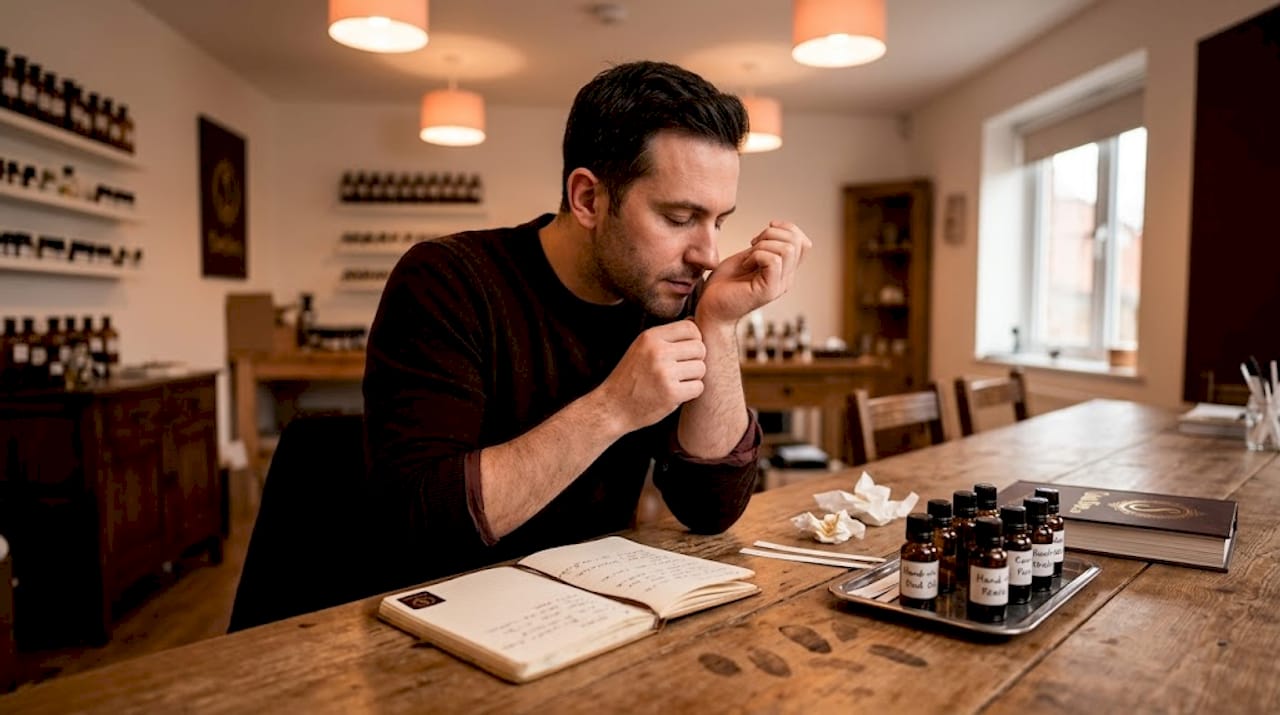
The first hour on skin is often the most intense. Oud tends to open with its most assertive facets, particularly the smokier and more animalic notes. Allow it time. After an hour or two, oud settles into a warmer, richer, more intimate presence that is genuinely seductive. This evolution is a hallmark of quality oud, and it is one of the defining pleasures of wearing it.
Blends, entry points and the oud journey
Once you have recognised oud’s nuance, you can explore how it features in different perfume blends. For those approaching oud for the first time, the sheer intensity of a pure oud oil can feel overwhelming. Blended oud perfumes offer a far more accessible entry point, and they are where most UK enthusiasts begin their journey.
Oud blends with rose are among the most beloved and accessible combinations in Middle Eastern perfumery. The softness of rose tempers oud’s wilder facets while adding a romantic, floral dimension that feels genuinely luxurious. Saffron is another classic pairing, lending a warm, slightly metallic spiciness that deepens the oud’s resonance. Amber and vanilla bring sweetness and creaminess, making the overall composition more immediately approachable to Western palates. As blended oud perfumes are considered the ideal entry point for UK users, this is almost always where we recommend you start.
For a clearer sense of your options, here is a simple comparison:
| Feature | Blended oud perfume | Pure oud oil |
|---|---|---|
| Intensity | Moderate to strong | Very strong |
| Accessibility | High for beginners | Better for connoisseurs |
| Complexity | Varied, layered | Raw, singular |
| Longevity | 6 to 12 hours typically | Can last 24+ hours |
| Application | Spray or rollerball | Dab directly on skin |
| Price range | Accessible to luxury | Often premium to rare |
Our beginner’s oud guide offers even more detailed advice for those just starting out, while our guide to oud vs parfum differences explains why oud oils and Extrait de Parfum concentrations often behave quite differently on the skin. If you are debating between oud and something warmer and resinous, our piece on oud vs amber breaks down the key distinctions beautifully.
Here are simple steps to begin your personal oud journey:
- Start blended. Choose an oud rose or oud amber blend rather than a pure oil to allow your senses to acclimatise.
- Wear it at home first. Give yourself space to experience how the scent develops over several hours in a low-stakes environment.
- Apply to warm pulse points. Wrists, inner elbows, and the base of the throat encourage sillage without over-projecting.
- Try different origins. Cambodian, Indian, and Arabic oud compositions each have distinct personalities. Sample broadly.
- Build your palate. Over time, your nose will learn to distinguish and appreciate each facet. Oud is a journey, not a destination.
Pro Tip: Always sample oud on your skin rather than a paper strip. Oud interacts profoundly with your body chemistry, and it can smell entirely different on you than it does on someone else. Give it at least two hours before deciding whether the scent is for you.
How to choose and gift oud: testing, quality and UK tips
Ready to make oud part of your everyday routine, or to find the perfect gift? Making smart choices comes down to understanding authenticity, quality markers, and how to test effectively.
Authenticity is the cornerstone of a satisfying oud purchase. In the UK, genuine oud products should ideally be traceable to responsibly managed sources, with CITES-regulated authentic sources being the gold standard for wild or semi-wild Agarwood ingredients. Reputable suppliers will be transparent about their sourcing, and this transparency is itself a quality signal. Synthetic oud, while sometimes skillfully crafted, will rarely achieve the depth and complexity of the genuine article.
When testing oud scents, keep the following in mind:
- Test on skin, not paper. Paper strips give you a surface impression. Skin gives you the full story, including how the base notes develop over hours.
- Allow time for evolution. Oud’s opening notes can be its most intense. Return to the scent after 30 minutes, one hour, and two hours to appreciate its full journey.
- For pure oils, gentle heat helps. Dabbing a small amount on a warm pulse point, or even warming the stopper briefly between your palms, releases the aromatic compounds more fully and reveals the oil’s true character.
- Assess longevity. Genuine oud, especially in oil form, should remain perceptible on your skin for many hours, sometimes into the following day.
- Trust your instincts. Quality oud should feel smooth and balanced, even at its most intense. Harshness, a sharp synthetic edge, or an odour that fades within an hour are warning signs.
Gifting oud is one of the most generous and memorable choices you can make. For someone new to oud, blended fragrances are far more universally appealing than pure oils. An oud rose or an oud amber scent, beautifully presented, makes an exquisite gift for birthdays, anniversaries, or any occasion that calls for something genuinely special. Discovery sets and travel sizes allow the recipient to explore several facets of oud before committing to a full bottle. For a more seasoned fragrance enthusiast, a higher-grade oil or an Extrait de Parfum concentration will demonstrate real expertise and thoughtfulness.
The choosing oud fragrance process need not be daunting. With the right guidance, it becomes one of the most rewarding aspects of fine fragrance appreciation.
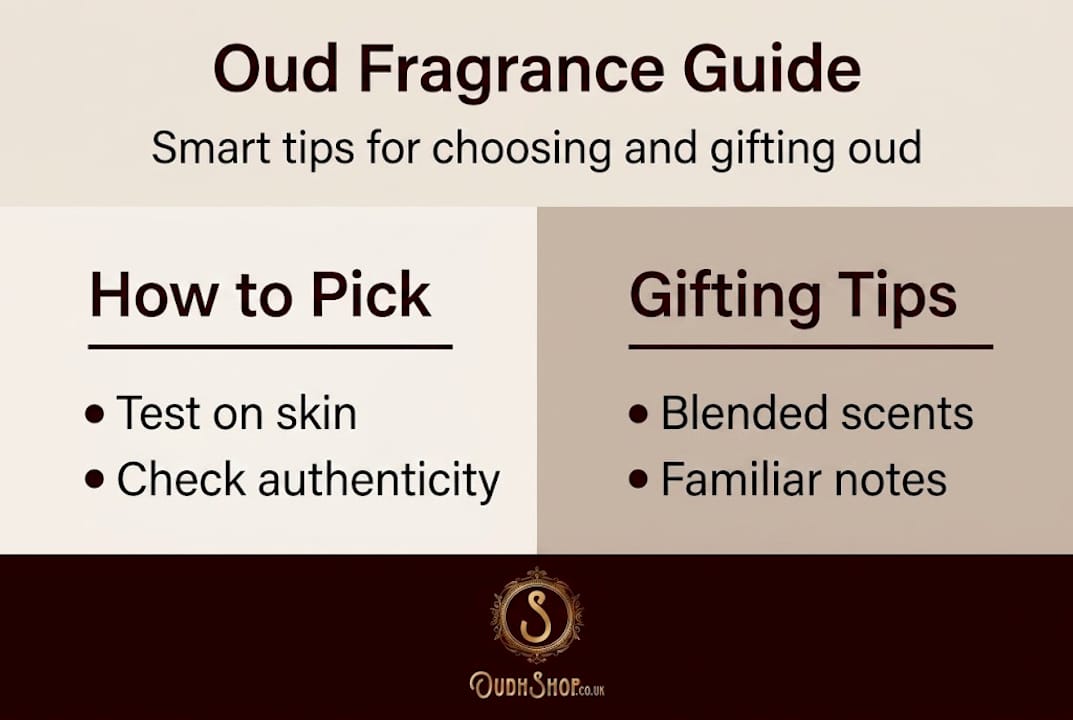
Pro Tip: If you are gifting oud to someone unfamiliar with it, opt for a blend featuring rose, vanilla, or amber. These familiar notes act as gentle bridges, easing the recipient into oud’s world without overwhelming their senses on first encounter.
Why oud divides the room—and why that’s its superpower
Here is an opinion worth sitting with: the fragrances that provoke the strongest reactions are almost always the ones worth knowing. Oud does not sit quietly in the background. It asserts itself, demands engagement, and refuses to be ignored. For some, this is immediately magnetic. For others, it takes time.
That division is not a flaw. It is the essence of oud’s allure. Most things of genuine cultural and artistic weight divide opinion at first. Consider how many celebrated wines, cheeses, or musical styles feel acquired. Oud operates in exactly the same territory. The initial challenge is the beginning of a deeper relationship, not a rejection.
What changes with exposure is not the scent itself but your relationship to it. Fragrance memory is deeply personal and cultural. As you spend more time with oud, those notes that once seemed confronting begin to feel familiar, then comforting, then utterly compelling. Many who once wrinkled their nose at oud now count it among their most treasured possessions. There is a quiet pride in wearing something that speaks of centuries of tradition, craftsmanship, and the luxury of authentic oud culture. The bold choose oud. And in choosing it, they join a legacy that stretches across centuries and continents.
Discover authentic oud: next steps for UK enthusiasts
If this guide has sparked genuine curiosity, the most rewarding next step is to experience authentic oud for yourself.
At Oudh Shop, we have curated a range of exquisite oud fragrances to suit every stage of the journey, from accessible blended scents for the curious newcomer to rare and refined oils for the seasoned connoisseur. You can browse oud perfumes across a wide selection of styles, origins, and concentrations, or use our intuitive find your oud tool to receive personalised recommendations based on your scent preferences. If you are shopping for someone special, our beautifully presented oud gifts include discovery sets and travel sizes that make genuinely memorable presents for any occasion. Let the journey begin.
Frequently asked questions
What does oud actually smell like?
Oud has a woody, smoky, animalic scent with resinous, earthy, and sometimes sweet or leathery notes, making it one of the most intense and complex natural fragrance ingredients in the world.
Why does oud smell so different to UK or Western noses?
Oud’s powerful animalic and smoky facets are far removed from the lighter floral and citrus traditions of British and European perfumery, making it an acquired taste that rewards patience and repeated exposure.
How can I start wearing oud if I’m a beginner?
Begin with a blended oud perfume featuring familiar notes such as rose, vanilla, or amber, which soften oud’s intensity, before progressing to pure oud oils as your palate develops.
How can I tell if oud is authentic?
Look for CITES-certified sourcing, observe how the scent evolves on your skin over several hours, and for pure oils, apply gently to a warm pulse point to assess true depth and purity of character.