Luxury Arabian Oud Perfume Blog: Your Guide to Exquisite Fragrances
Oud vs amber fragrances: how to choose your signature scent
TL;DR:
- Oud is a rare, resinous wood creating deep, complex, and evolving scents.
- Amber offers warm, sweet, and stable fragrances ideal for everyday wear.
- Proper testing on skin and understanding seasonality enhances fragrance selection and longevity.
Few things divide a fragrance wardrobe quite like the choice between oud and amber. Both are celebrated as the cornerstones of Arabic perfume luxury, yet even seasoned UK collectors frequently confuse them, layer them incorrectly, or dismiss one without truly understanding it. Oud can smell startlingly smoky and animalic on one person, yet silky and woody on another. Amber, meanwhile, wraps the skin in warmth so effortlessly that it almost disappears into you. This guide unpacks their origins, scent profiles, longevity, and wearability so you can make a genuinely informed choice for your personal collection.
Table of Contents
- Understanding oud and amber: origins and allure
- Scent profiles: how oud and amber fragrances differ
- Longevity, projection, and seasonality: when and how to wear each
- Choosing and collecting: oud and amber in your UK fragrance wardrobe
- Why your perfect fragrance choice might surprise you
- Find your next signature oud or amber at Oudh Shop
- Frequently asked questions
Key Takeaways
| Point | Details |
|---|---|
| Origins matter | Oud and amber differ in raw material and cultural roots, informing their distinct scent. |
| Aroma evolution | Oud evolves over hours, while amber maintains a more constant, familiar scent. |
| Performance by season | Oud thrives in colder months and evenings; amber suits everyday wear and layering. |
| Try before you buy | Always test on your skin and buy from specialist UK fragrance retailers for authenticity. |
Understanding oud and amber: origins and allure
To truly understand their difference, let’s first discover what makes oud and amber so distinctive and desirable.
Oud, also known as Agarwood, is a resinous heartwood that forms inside Aquilaria trees when they become infected with a particular mould. The tree responds by producing a dark, aromatic resin, and it is this resin that perfumers distil into oud oil. The process is slow, rare, and extraordinarily costly, which is precisely why oud is often called the liquid gold of the fragrance world. Oud is prized for its deep, resinous aroma and cultural history, having been burned as incense and worn as perfume across the Middle East, South Asia, and East Asia for centuries.
Amber is a different story entirely. True ambergris, the waxy substance produced in the digestive tract of sperm whales, was historically one of perfumery’s most treasured fixatives. Today, virtually all amber used in modern fragrances is a synthetic or semi-synthetic accord, typically blending labdanum resin, benzoin, and vanilla to recreate that warm, resinous sweetness. This means amber is far more accessible and consistent than oud, which still varies dramatically depending on its geographic origin.
“Oud and amber are the twin pillars of Eastern perfumery. One challenges you; the other comforts you. Together, they represent the full emotional spectrum of scent.”
What draws collectors to both notes is their depth and longevity. Neither sits quietly on the surface of the skin. They settle into the base of a fragrance and anchor everything above them. Here is why both notes captivate so powerfully:
- Oud carries cultural gravitas, centuries of ritual, and an almost living quality that shifts as it warms on your skin.
- Amber offers universal warmth, a smooth sweetness that feels intimate and familiar, like a second skin.
- Both notes are powerful fixatives, meaning they extend the life of every other ingredient in the blend.
- Neither is gender-specific, making them ideal foundations for a truly personal signature scent.
Scent profiles: how oud and amber fragrances differ
Now that we’ve explored their origins, let’s clearly compare how oud and amber smell and behave.
Oud is complex, almost confrontational at first. Its opening can register as smoky, barnyard-like, or intensely woody, which surprises many newcomers. As it dries down, it softens into leather, incense, and rich earth. Reading a good oud scent guide will reveal just how dramatically the note varies between Indian oud (dark, smoky, medicinal), Cambodian oud (sweet, floral, fruity), and Laotian oud (clean, cool, slightly aquatic). Understanding perfume notes explained in layers is essential here, because oud behaves very differently as a top note versus a base note.
Amber, by contrast, is immediately warm and enveloping. It opens with a soft, powdery sweetness, often edged with vanilla and a faint spice. It rarely surprises you. Instead, it reassures. The difference between the two in terms of eau de parfum vs oud concentration is also worth noting, as oud Extrait de Parfum formulations can be almost overwhelming in their intensity.

| Characteristic | Oud | Amber |
|---|---|---|
| Primary accord | Woody, resinous, smoky | Warm, sweet, powdery |
| Emotional feel | Bold, mysterious, animalic | Comforting, sensual, familiar |
| Skin behaviour | Evolves dramatically over hours | Relatively linear and stable |
| Complexity | High | Moderate |
| Typical use | Evening, formal, special occasions | Daytime, casual, layering |
Oud evolves on skin, creating a multi-hour experience, whereas amber tends to be more linear and stable. This is not a flaw in amber; it is actually what makes it so wearable every single day.
- Sample both on skin, not on paper strips, which flatten the true character of either note.
- Allow a full dry-down of at least 30 minutes before forming an opinion.
- Test in different temperatures, as warmth amplifies oud’s smokiness and amber’s sweetness.
- Layer thoughtfully: amber makes an excellent base under a lighter oud blend.
Pro Tip: Wear oud fragrances on evenings when you want a scent that tells a story and develops over hours. Choose amber when you want a comforting, consistent presence that works from morning meetings to afternoon walks.
Longevity, projection, and seasonality: when and how to wear each
Distinguishing the notes is just the beginning. Knowing when and how to wear oud and amber can transform your experience entirely.
Oud’s scent evolves dramatically over hours, making it ideal for evening or formal events, while amber’s smoothness lends itself to day-to-day wear. This distinction matters enormously in the UK, where the climate is cool and damp for much of the year. Cold air suppresses sillage, so heavier base notes like oud actually perform beautifully here, cutting through the grey with warmth and presence.
Longevity and sillage at a glance:
| Oud | Amber | |
|---|---|---|
| Average longevity | 6 to 8+ hours | 4 to 6 hours |
| Sillage (projection) | Strong to very strong | Moderate to strong |
| Best season | Autumn and winter | Year-round, especially spring |
| Best time of day | Evening and night | Morning and afternoon |
| Application tip | Pulse points, sparingly | Layered generously |
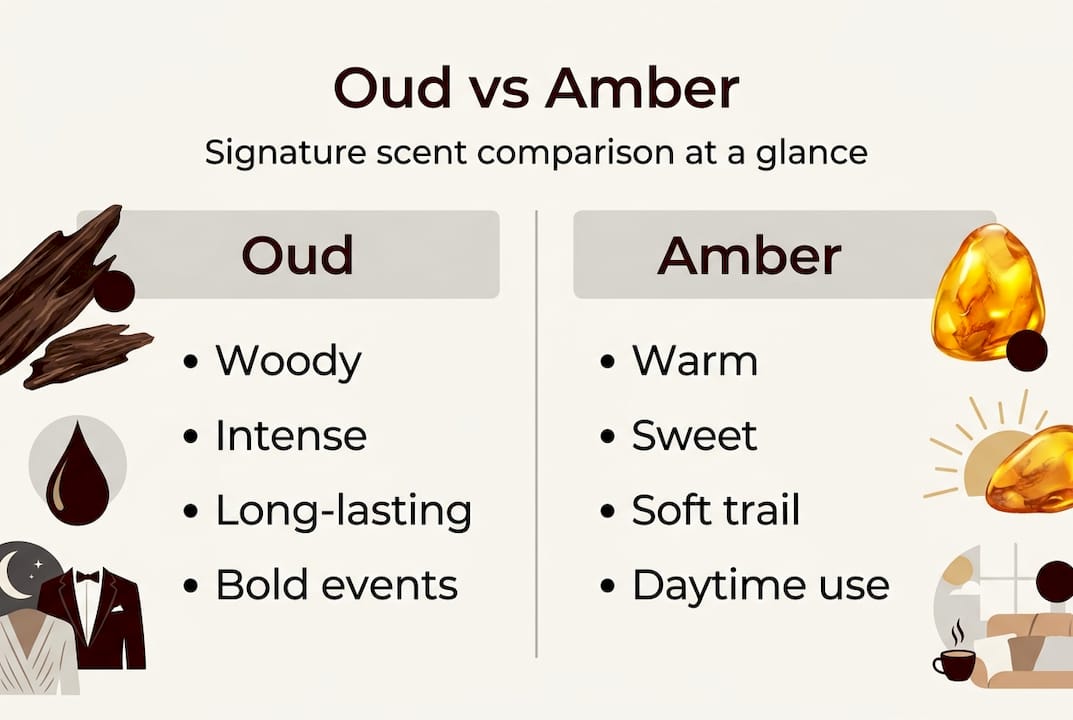
Oud blends can linger for 8 hours or more, which means a single application before leaving the house will carry you through an entire evening. Amber, while slightly shorter in longevity, rewards layering. Apply an amber body lotion beneath your fragrance and the effect doubles in richness and depth.
Here is how to get the most from each note across the UK seasons:
- Autumn and winter: Reach for premium oud in the UK market for its warming, enveloping character that pairs beautifully with wool coats and candlelit evenings.
- Spring: Amber-forward blends shine here, their sweetness echoing blossom and warmth without overpowering.
- Summer: Lighter oud blends or amber-citrus combinations work well, applied to hair and clothing for a gentler sillage.
- Formal occasions: A luxurious oud scent makes an unmistakable statement without requiring volume.
Choosing and collecting: oud and amber in your UK fragrance wardrobe
Once you’re drawn to oud or amber, making informed buying and collecting decisions ensures you build a wardrobe you’ll truly love.
The single most important rule is this: never buy a fragrance you haven’t worn on your skin for at least an hour. Paper strips are useful for eliminating obvious mismatches, but skin chemistry transforms both oud and amber in ways that are impossible to predict from a blotter alone. Your skin’s pH, moisture level, and even your diet can shift how a note performs.
Building a balanced collection means thinking in terms of occasions and seasons, not simply preferences. A well-rounded wardrobe might include one bold oud Extrait de Parfum for evenings, one amber-led Eau de Parfum for daily wear, and one oud-amber blend that bridges both worlds beautifully.
Pro Tip: Build your collection with at least one year-round amber anchor and one statement oud for special occasions. This pairing covers virtually every context and ensures you’re never without the right scent.
Common pitfalls to avoid when buying oud and amber in the UK:
- Buying from unreliable online sources: Synthetic oud of poor quality smells harsh and chemical, nothing like the real thing.
- Falling for hype alone: A high price does not guarantee quality. Always test before committing to a full bottle.
- Ignoring concentration: An Eau de Toilette with oud will behave very differently from an Extrait de Parfum version of the same blend.
- Skipping the dry-down: Both oud and amber reveal their true character only after 20 to 30 minutes on skin.
UK enthusiasts should prioritise trusted retailers like Oudh Shop for authentic oud blends. When exploring the oud and musk shop, look for detailed scent descriptions, origin information, and customer reviews that mention longevity and projection. If you’re new to Arabian oils, a dedicated Arabian oils buying guide will help you navigate the enormous variety available without feeling overwhelmed.
Why your perfect fragrance choice might surprise you
Here is something we’ve observed time and again: the fragrance that initially unsettles you is often the one that becomes your most treasured possession.
Many people approach oud cautiously, put off by its intensity or unfamiliarity. They gravitate towards amber first because it feels safe. And there is absolutely nothing wrong with that. But we’d encourage you to resist the urge to categorise either note as ‘yours’ or ‘not yours’ too quickly. Skin chemistry, mood, memory, and even the season you first encounter a scent all shape your perception profoundly.
Trying both oud and amber side by side, on each wrist, on the same afternoon, is the only way to truly experience their arc and allure. Discovering unique oud scents is rarely a linear journey. The scent that challenges you on first wear often reveals extraordinary depth on the third or fourth encounter. That is the nature of truly great fragrance: it rewards patience and curiosity in equal measure.
Find your next signature oud or amber at Oudh Shop
Having explored what makes oud and amber so compelling, finding your new favourite is just a step away.
At Oudh Shop, we’ve curated a collection that honours the full spectrum of both notes, from approachable amber-led blends perfect for everyday wear to exquisite, deep oud Extraits de Parfum for those landmark evenings. Whether you’re building your first serious collection or adding a statement piece to an existing wardrobe, our range has been selected with discerning UK fragrance lovers in mind.
Explore our full oud perfumes shop to browse by note, occasion, or concentration. Not sure where to begin? Our perfume finder guides you to your ideal match in minutes. And if you’re looking for a truly memorable gift, our beautifully presented perfume gifts collection makes the perfect choice for any occasion.
Frequently asked questions
Is oud or amber longer-lasting on skin?
Oud’s longevity can extend to over eight hours, making oud fragrances generally longer-lasting than amber on skin. Amber typically performs for four to six hours, though layering techniques can extend its presence considerably.
Are oud and amber fragrances suitable for both men and women?
Oud and amber are popular unisex choices in the UK market, and both notes appear across masculine, feminine, and gender-neutral blends. The right choice depends entirely on the specific formulation and your personal preference.
How can I tell if a fragrance is more oud or amber?
Check the listed base notes carefully. Oud is known for resinous and woody characteristics, while amber presents as warm, sweet, and powdery. If the description mentions Agarwood, smoke, or leather, oud dominates; if it references vanilla, benzoin, or warmth, amber leads.
Where can I buy authentic oud and amber fragrances in the UK?
UK fragrance seekers should look to specialist retailers such as Oudh Shop, which offers a carefully tested range of authentic oud and amber blends suited to every taste and budget.