Luxury Arabian Oud Perfume Blog: Your Guide to Exquisite Fragrances
Perfume categories explained: a guide for fragrance lovers

TL;DR:
- Perfume classification helps consumers and perfumers communicate about scents more effectively.
- The four main fragrance families are Floral, Fresh, Woody, and Amber/Oriental, each with unique characteristics.
- Arabian and oud perfumes often blur categories, combining notes and traditions for complex, layered scents.
Even the most devoted fragrance enthusiast can feel genuinely overwhelmed when faced with rows upon rows of bottles, each promising something unique, complex, and deeply personal. The language of perfumery, with its note pyramids, olfactory families, and overlapping subfamilies, can feel more like a labyrinth than a signpost. The truth is that most perfumes, especially the richest Arabian and oud blends, are intricate compositions that resist being neatly boxed. Once you understand the key classification systems, however, selecting your next signature scent becomes far less daunting and far more rewarding.
Table of Contents
- Why perfumes are categorised and why it matters
- An overview of the main fragrance families
- How the olfactory pyramid shapes each perfume
- Why so many perfumes don’t fit just one category
- How to use categories to choose your next oud or Arabian scent
- What most perfume guides miss about categorising oud and Arabian blends
- Ready to find your perfect perfume? Explore curated oud and Arabian scents
- Frequently asked questions
Key Takeaways
| Point | Details |
|---|---|
| Fragrance families explained | Perfumes are grouped into families like Floral, Fresh, Woody, and Amber for easier selection. |
| Olfactory pyramid basics | Understanding top, heart, and base notes reveals how a scent develops on the skin. |
| Hybrids abound | Most perfumes, especially Arabian blends, cross family boundaries for unique character. |
| Practical shopping insight | Using categories helps you choose oud and Arabian perfumes with greater confidence. |
Why perfumes are categorised and why it matters
To lay the groundwork, it is important to know why perfume is sorted into categories in the first place. Fragrance classification has a surprisingly long history. Perfumers and industry professionals needed a shared language to describe and compare scents, much the way sommeliers use terminology to distinguish wines from different regions and vintages. By the mid twentieth century, formal systems had emerged to bring order to an art form that is, by nature, deeply subjective.
Classification systems serve several practical purposes. They help consumers communicate what they enjoy, even when words fail them. They allow perfumers to position new creations within a recognisable context. And for enthusiasts drawn to perfume families explained through blogs, guides, and fragrance communities, categories provide a starting vocabulary that makes the entire conversation richer.
“Classification systems for fragrance are useful maps, but they are not the territory itself. The real experience of a scent lives on your skin, in your memory, and in the moment.”
It is worth noting that not everyone agrees on how many families exist or how to define them. Fragrance families overlap considerably because perfumes are genuine hybrids, not tidy specimens. Renowned industry authority Michael Edwards built his “Fragrance Wheel” around four families with fourteen subfamilies. Some UK fragrance sites favour five families, adding Gourmand as a distinct group. Others, including the Perfume Society, incorporate Fougère and Chypre as essential families in their own right. The key takeaway: categories are guides, not rules.
Pro Tip: When you read a perfume’s classification, treat it as a general orientation rather than a guarantee of exactly how it will smell. Your skin chemistry, body temperature, and even diet all influence how a fragrance develops once worn.
Arabian and oud perfumes are particularly fascinating in this context because they have their own centuries-old tradition of blending that frequently sidesteps Western classification entirely. A single oud attar might contain resins, spices, florals, and smoke in such a seamlessly layered way that it defies any single family label.
An overview of the main fragrance families
Having explained the ‘why,’ let’s look at which fragrance families most scents belong to. According to established frameworks, the four main fragrance families are Floral, Fresh, Woody, and Amber/Oriental, each containing a rich variety of subfamilies that allow for remarkable nuance.
| Family | Key notes | Common subfamilies | Typical character |
|---|---|---|---|
| Floral | Rose, jasmine, peony, iris | Soft Floral, White Floral, Floral Oriental, Fresh Floral | Romantic, feminine, blooming |
| Fresh | Citrus, marine, green, aquatic | Citrus, Aromatic, Green, Water/Aquatic | Clean, bright, invigorating |
| Woody | Sandalwood, cedar, vetiver, oud | Dry Woods, Mossy Woods, Vetiver | Earthy, grounding, sophisticated |
| Amber/Oriental | Vanilla, resins, amber, spices | Soft Oriental, Woody Oriental, Amber Vanilla | Warm, sensual, opulent |
Each family evokes a genuinely distinct emotional landscape. Floral fragrances, with their romantic rose and ethereal jasmine accords, remain the world’s best-selling category. Fresh scents, anchored by zesty citrus and aquatic green notes, convey effortless cleanliness and vitality. Woody fragrances, where sandalwood, cedar, and above all the precious agarwood known as oud reside, feel grounding and authoritative. Amber/Oriental blends are perhaps the most relevant for lovers of Arabic scent families, being luxuriously warm, spiced, and often deeply long-lasting.
Beyond these four, it is genuinely worth understanding a few additional families that are especially relevant to sophisticated noses. Gourmand fragrances, built around edible notes such as caramel, chocolate, and vanilla, have surged in popularity over recent decades. Chypre, named for the island of Cyprus, blends bergamot, oakmoss, and labdanum for a mossy, woody-citrus contrast. Fougère, meaning “fern” in French, blends lavender, coumarin, and oakmoss into aromatic, herbaceous compositions often found in classic masculine fragrances.
Understanding which of these categories appeal to your personal palette is the foundation of shopping with confidence. If you know you are drawn to warm, resinous depth, you can immediately orient yourself towards Amber/Oriental and Woody Oriental selections rather than spending time exploring light, watery Aquatics. A well-structured perfume type guide can make this selection process even more precise.
How the olfactory pyramid shapes each perfume
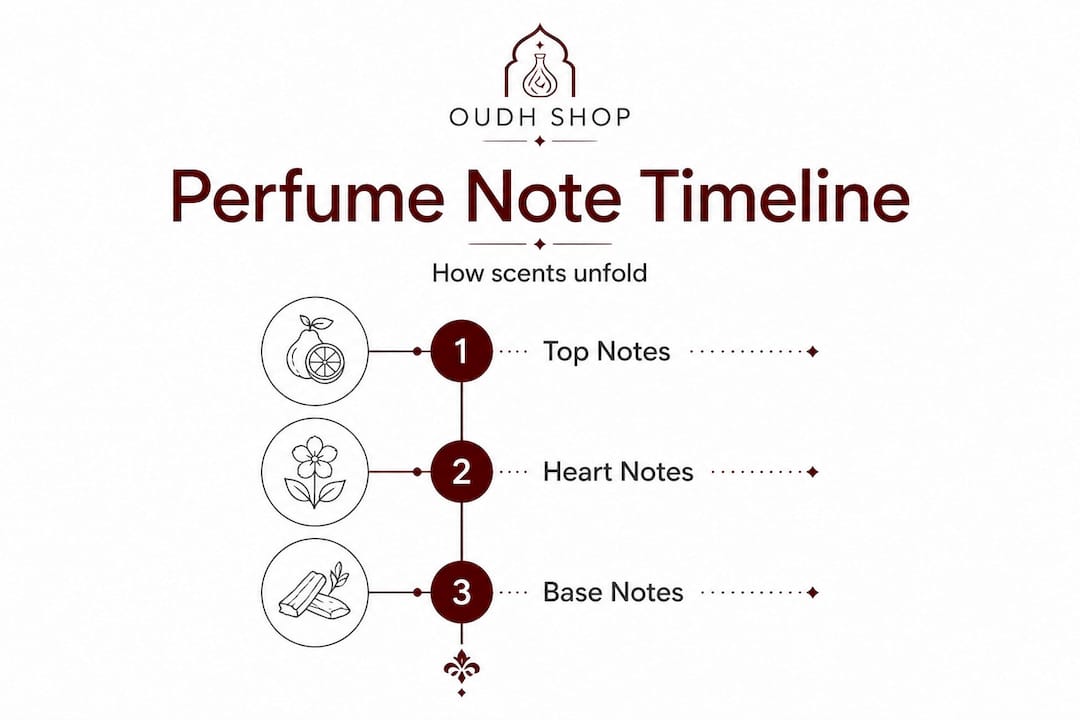
Knowing the families gives you the big picture, but understanding the note structure explains how a fragrance actually ‘unfolds’ on your skin. The olfactory pyramid, sometimes called the fragrance pyramid or scent pyramid, is the structural framework that describes how a perfume evolves over time from first spray to final dry-down.
The pyramid has three distinct levels, each defined by the volatility and longevity of its constituent ingredients. Top notes evaporate within five to thirty minutes and make that all-important first impression. Heart or middle notes emerge as the top notes fade, typically lasting between thirty minutes and four hours, and they represent the true character of the fragrance. Base notes are the slowest to evaporate, anchoring the scent for four hours or longer, and they are where the most lasting, memorable impressions live.
- Top notes (5 to 30 minutes): These are the opening flourish. Common top notes include bergamot, lemon, grapefruit, pink pepper, and light aldehydes. They are vibrant but fleeting.
- Heart notes (30 minutes to 4 hours): The soul of the fragrance. Jasmine, rose, geranium, cardamom, saffron, and nutmeg are classic heart notes. They carry emotional weight and define the scent family most clearly.
- Base notes (4 hours and beyond): The foundation that lingers. Oud, sandalwood, musk, amber, labdanum, and patchouli are quintessential base notes, building sillage (the scented trail a perfume leaves) and lasting power.
For those drawn to oud and Arabian perfumery, this pyramid is particularly illuminating. These traditions have long favoured richly saturated base notes, meaning the fragrance often deepens and becomes more rewarding as the hours pass. An oud attar may open with a flicker of rose or saffron, but its true grandeur reveals itself slowly, in the base, where the resinous, smoky, leathery character of agarwood comes fully alive.
Pro Tip: When testing a new oud or Arabian perfume, don’t judge it within the first five minutes. Allow at least thirty minutes on your skin before making a decision, as the heart and base notes will transform the fragrance completely.
Understanding note evaporation and scent duration is also essential when thinking about when and where to wear a particular scent. A citrus-forward top note may be perfect for a morning commute, while a rich base-heavy oud blend will truly shine through an evening gathering, its sillage becoming an intimate signature.
Why so many perfumes don’t fit just one category
Even with all these frameworks, there’s no neat box that fits every bottle. Modern perfumery, particularly in the Arabian and Middle Eastern tradition, thrives on layering and blending in ways that genuinely blur the lines between families. This is not an accident; it is a philosophy.
Classifications overlap because today’s perfumers, whether working in Grasse or Dubai, are not bound by academic rules. They build scents from lived experience, cultural memory, and creative ambition. A single bottle may present as a Floral Oriental but carry the dry smokiness of a Woody, the sweetness of a Gourmand, and the tartness of a Fresh citrus opening, all at once.
Common hybrid combinations you will encounter in Arabian fragrance design include:
- Floral Woody Musk: Rose, oud, and white musk intertwined; both tender and tenacious.
- Spicy Amber: Cardamom and saffron lifted by warm vanilla-infused amber; deeply sensual and memorable.
- Woody Oriental: Agarwood, sandalwood, and incense wrapped in exotic resins; the heartland of classical oud perfumery.
- Fresh Chypre: Bergamot and neroli over a mossy, woody base; a bridge between Western and Eastern traditions.
“The most extraordinary fragrances are often the ones that refuse to be classified. They are conversations, not monologues.”
This is precisely why enthusiasts who explore Middle Eastern perfume hybrids find the experience so endlessly rewarding. There is always another layer to discover, another note that surfaces under different conditions, a different time of day, or a different season.
When shopping, resist the urge to limit yourself by a single family label. Instead, use families as directional guidance. If you enjoy warm, spiced Orientals, explore Woody Oriental and Soft Oriental alongside each other. You may find that your absolute favourite scent sits right on the border, speaking the language of both.
How to use categories to choose your next oud or Arabian scent
Armed with a better understanding of the categories and pyramids, you’re ready to tackle choosing your next perfume. The key is a brief, honest self-assessment of what you already love, followed by a methodical approach to reading and testing.
- Identify your existing favourites. Think about perfumes you have worn and loved. Were they light and citrusy, or deep and resinous? Warm and spiced, or clean and fresh? Match these impressions to the families above and notice which descriptions resonate most strongly with you.
- Define the occasion and season. Fresh and Floral families tend to suit warmer months and daytime wear beautifully. Amber/Oriental and Woody blends come into their own during autumn and winter, and in evening settings, where their warmth and projection feel most natural.
- Read the note pyramid carefully. When browsing a product description, look for the top, heart, and base notes listed. If the top notes evaporate quickly and the heart and base are where your interest lies, that is your most reliable guide to what you will actually wear day to day.
- Use curated tools to narrow your options. Online resources designed for fragrance discovery can save you considerable time. A well-built perfume finder allows you to filter by family, note, and occasion rather than browsing blindly.
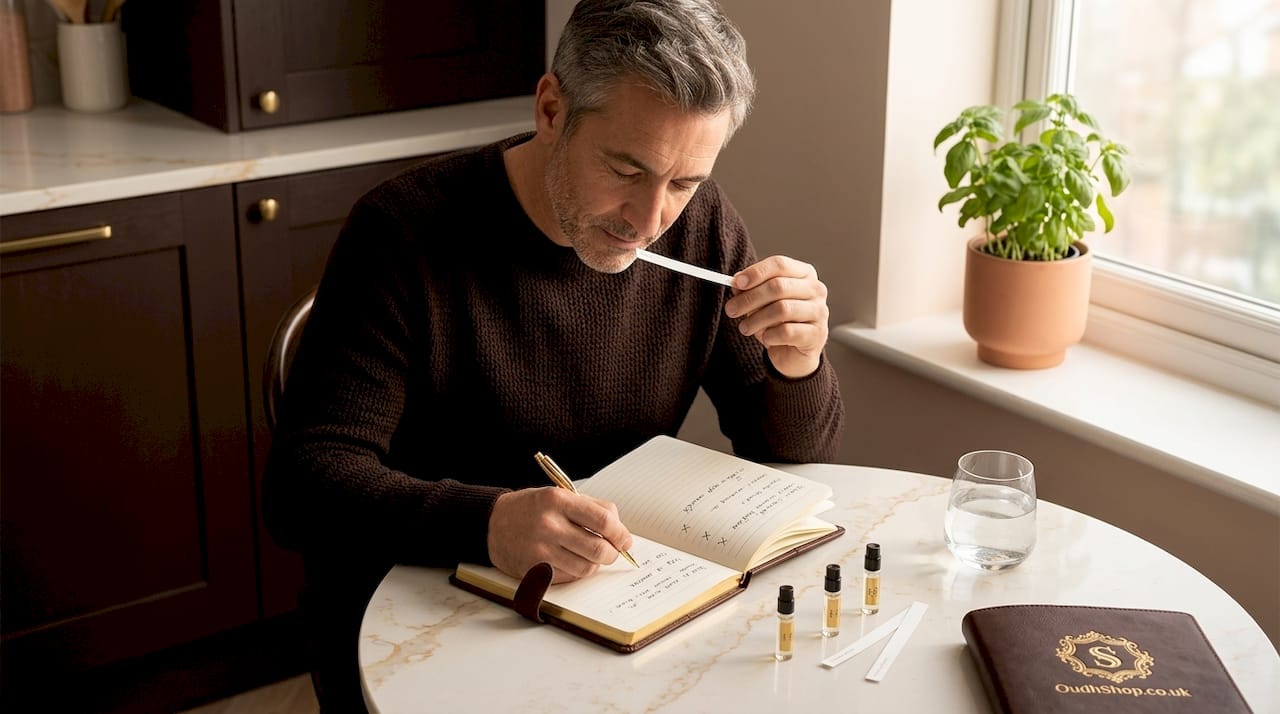
- Start with smaller formats or discovery sets. Rather than committing to a full bottle, sampling allows you to test how a fragrance evolves on your specific skin chemistry, which is the only reliable test that truly matters.
Pro Tip: When using finding your signature scent tools online, be as specific as possible about notes you already love. “I enjoy oud, rose, and cardamom” will deliver far more targeted results than “I want something Oriental.”
The combination of family knowledge and pyramid awareness transforms you from a passive consumer into a genuinely informed one. You begin to read fragrance descriptions the way a musician reads a score, understanding what each element contributes to the whole before a single note is played.
What most perfume guides miss about categorising oud and Arabian blends
Stepping back, here’s a crucial point often left out of most guides. Western fragrance classification systems were largely developed by European perfumers and critics, drawing on a tradition rooted in Grasse, Paris, and London. Arabian perfumery, by contrast, has its own deeply ancient lineage, one that predates many of these formal frameworks by centuries.
In the Middle Eastern tradition, blending is not simply a technique but a form of storytelling. Attars, bakhoor, and oud oils are composed with an understanding that scent is inseparable from memory, hospitality, and spiritual experience. The goal is rarely to fit a family; it is to evoke a place, a moment, or an emotion so precisely that the wearer carries it with them like a living artefact.
This is why Arabian perfumes so consistently delight by blurring boundaries. A masterful oud composition might open with the brightness of bergamot, transition through a heart of rose and saffron, and then settle into an extraordinary base of smouldering agarwood, civet, and amber that clings beautifully to fabric for days. No single family label does this justice. Calling it “Woody Oriental” is accurate but insufficient.
We believe the most liberating thing you can do as a fragrance enthusiast is to treat categories as your starting point and then consciously move beyond them. Use the families to orient yourself, use the note pyramid to anticipate how a scent will develop, and then explore modern oud choices with genuine curiosity rather than a rigid checklist. The bottles that surprise you the most are often the ones you will treasure longest.
Ready to find your perfect perfume? Explore curated oud and Arabian scents
You now have the knowledge to approach any fragrance counter or online collection with genuine confidence, understanding how families are defined, how note pyramids shape the journey from first impression to lasting dry-down, and why the most captivating scents often refuse to be categorised neatly.
At Oudh Shop, we have curated a collection where every fragrance has been selected for its depth, authenticity, and ability to tell a story. Whether you are drawn to the smoky grandeur of pure agarwood or the sensual warmth of a Soft Oriental blend, you will find it when you browse all oud and Arabian perfumes in our collection. If you are searching for a gift that feels truly considered and memorable, our perfume gift sets offer beautifully presented selections that reflect the very best of Middle Eastern perfumery. Your signature scent is waiting.
Frequently asked questions
What are the main fragrance families in perfume?
The four main fragrance families are Floral, Fresh, Woody, and Amber/Oriental, each with distinct subfamilies such as White Floral, Dry Woods, and Soft Oriental that offer further nuance for discovery.
How long do different perfume notes last?
According to the structure of the olfactory pyramid, top notes last just five to thirty minutes, heart or middle notes persist for thirty minutes to four hours, and base notes can last four hours or considerably longer on skin and fabric.
Can a perfume belong to more than one category?
Absolutely. Classifications overlap extensively because most perfumes are genuine hybrids, and Arabian and oud blends in particular are celebrated precisely for spanning multiple families within a single composition.
How can fragrance families help me choose a perfume?
Knowing which families appeal to your senses gives you a reliable filter when browsing, directing you towards scents that align with your existing preferences for warmth, freshness, floral softness, or earthy depth without testing every bottle.
What makes Arabian perfumes distinct in categorisation?
Arabian perfumes are distinguished by their masterful use of rich base notes, particularly oud, amber, and resins, and their creative blending tradition means they consistently cross conventional family boundaries in ways that make them uniquely complex and rewarding to wear.
Recommended
- The Ultimate Guide to Perfume Types: Understanding EDP, Extrait, EDT, and Oils |
- Perfume Finder | Authentic Oud Perfume & Attar | Oudh Shop – Longlasting Scents
- Find your signature scent: a guide to oud and Arabian perfumes
- Discover attar perfume: Your guide to natural fragrance oils
- Types of perfume notes: Unlock fragrance layers and lasting power – ThePerfumeSampler