Luxury Arabian Oud Perfume Blog: Your Guide to Exquisite Fragrances
How to identify authentic oud: a guide for fragrance lovers

TL;DR:
- Counterfeit oud is more common than most realize and deprives buyers of its transformative value. Authentic oud derives from infected Aquilaria trees producing complex resinous wood, but the market is flooded with synthetic and mislabelled products. Combining sensory evaluation with scientific tools like GC-MS analysis ensures reliable identification of genuine oud and preserves its rich cultural heritage.
Counterfeit and mislabelled oud is far more widespread than most enthusiasts realise, and the consequences of purchasing an inauthentic bottle go well beyond wasted money. They rob you of an experience that, when genuine, is genuinely transformative. Oud, often called “liquid gold” in the world of perfumery, is one of the most precious and complex raw materials on the planet, and yet the market is saturated with synthetic alternatives, diluted blends, and outright fakes. This guide equips you with everything you need, from expert sensory techniques to cutting-edge scientific methods, to confidently identify authentic oud every single time.
Table of Contents
- What makes oud ‘authentic’?
- Tools and resources you’ll need to identify oud
- How to perform a sensory check: step-by-step guide
- Scientific methods for verification: beyond the nose
- Common pitfalls and mistakes to avoid
- Why scientific analysis should complement tradition, not replace it
- Explore authentic oud with trusted experts
- Frequently asked questions
Key Takeaways
| Point | Details |
|---|---|
| No single oud aroma | Authentic oud smells different depending on its origin, wood species, and processing. |
| Sensory testing matters | Trust your nose, but compare samples and be aware of common counterfeits. |
| Lab analysis is conclusive | GC-MS reveals true marker compounds and confirms genuine oud. |
| Mistakes are common | Relying on stereotypes or price can lead to costly errors—research and supplier reputation are vital. |
| Blend tradition with science | The best oud enthusiasts combine sensory skills with analytical facts for ultimate confidence. |
What makes oud ‘authentic’?
Authentic oud, at its core, is the resinous heartwood of Aquilaria trees that have been infected with a specific mould. The tree responds to this infection by producing a rich, dark resin within its wood. This resin, once distilled or processed, yields the extraordinarily complex oil known as agarwood oil or oud oil. The process is entirely natural, unpredictable, and time-consuming, which is precisely why genuine oud commands such extraordinary prices.
One of the most persistent sources of confusion in the market is the mislabelling of synthetic oud or oud-accord products as “pure oud.” Fragrance houses and smaller vendors alike sometimes use the word “oud” loosely, applying it to compositions that contain little to no genuine agarwood resin. Understanding oud’s unique aroma is your first line of defence against these substitutions.
A common misconception among newcomers is the belief that authentic oud has a fixed, recognisable smell. This is simply not the case. As noted in fragrance community discussions, oud’s odour profile varies widely by region, species, and distillation or processing method, so comparing a new sample to a single remembered impression can mislead even experienced noses. Cambodian oud smells nothing like Hindi oud, and Thai oud diverges from both. Authentic oud is not a single scent; it is a family of extraordinarily varied scents.
Key indicators that oud may be inauthentic include:
- An overly uniform or one-dimensional sweetness that never shifts or evolves.
- A price that seems impossibly low for a product claiming to be pure oud oil.
- A sharp chemical top note that fades quickly, leaving little warmth or depth.
- Labelling that is vague about origin, species, or distillation method.
- An absence of the characteristic animalic, woody, or smoky facets that define real agarwood.
Tools and resources you’ll need to identify oud
With an understanding of what gives oud its authenticity, let’s look at the tools and resources to help your identification journey.
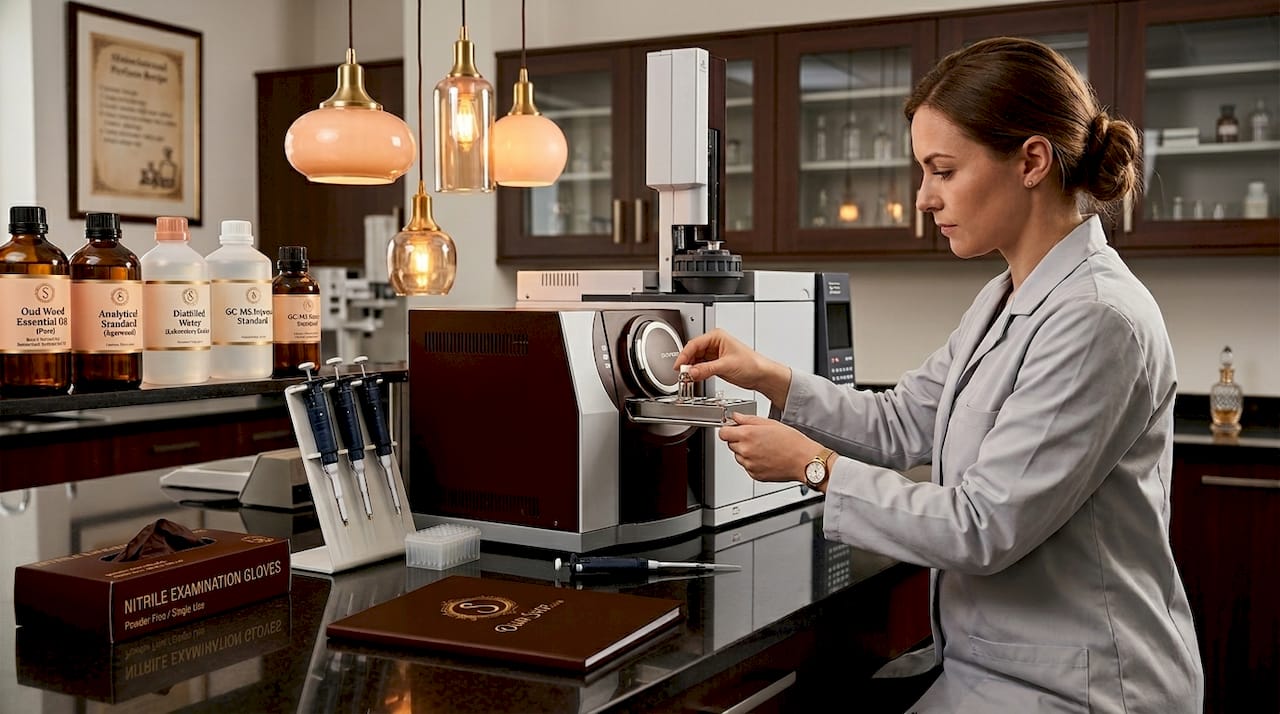
Authentication operates at two distinct levels: the sensory, which any dedicated enthusiast can develop over time, and the analytical, which requires specialist laboratory equipment. Both matter, and the most reliable outcomes combine both approaches.
At the sensory level, you will need the following:
- A high-quality reference sample of known authentic oud from a reputable supplier, which serves as your benchmark.
- Unbleached scent test strips, which allow you to evaluate the fragrance as it dries down over several hours without skin chemistry influencing the result.
- A clean palate: avoid strong food, coffee, or other fragrances immediately before testing.
- A fragrance journal, where you can document your sensory impressions over time and compare notes across different samples.
At the analytical level, laboratory-grade verification relies on GC-MS analysis (gas chromatography-mass spectrometry), a technique that separates and identifies the individual chemical components of an oil. This method produces a unique “fingerprint” for genuine agarwood that simply cannot be faked.
Pro Tip: When sourcing a reference sample, always purchase from a supplier with verifiable provenance, ideally one who can share documentation of the wood’s origin and the distillation method used. The unique oud ingredients in your reference oil are the foundation of every comparison you will make thereafter.
| Tool | Level | Purpose |
|---|---|---|
| Scent strips | Beginner | Safe, neutral surface for evaluation |
| Reference oud sample | Intermediate | Authentic comparison benchmark |
| Fragrance journal | Intermediate | Track impressions and patterns |
| GC-MS analysis | Expert/lab | Chemical fingerprint verification |
| Reputable supplier documentation | All levels | Provenance and chain-of-custody records |
How to perform a sensory check: step-by-step guide
Armed with the right tools, it’s time to explore a hands-on process for testing oud’s authenticity through your senses.
The sensory method is more art than science, but it is a disciplined art. Follow these steps carefully to build your assessment with confidence.
Acquire a reference sample. Before evaluating any new oud, you must have a trusted benchmark. Use a well-reviewed pure oud oil from a reputable source. Our beginner’s guide to oud recommends starting with a well-regarded Hindi or Cambodian oil, as these represent two of the most distinct and widely available authentic profiles.
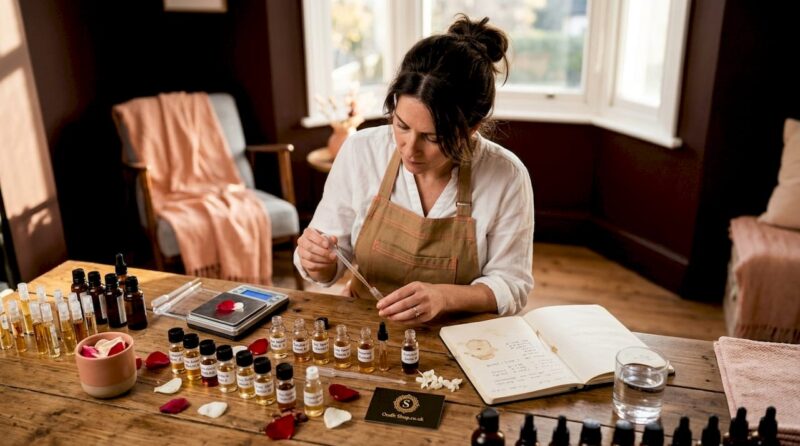
Apply both oils to separate scent strips. Label each strip clearly and apply a very small amount of each oil. Avoid touching the strips with your fingers to prevent contamination.
Assess the opening notes. At first application, genuine oud typically reveals something complex: an initial animalic or smoky burst, sometimes accompanied by a slight barnyard quality in Hindi oud, or a cooler, sweeter woodiness in Cambodian oud. An overly clean or uniform opening is a warning sign.
Wait and observe the dry-down. This is critical. Genuine oud evolves dramatically over thirty minutes, two hours, and beyond. Regional and processing variation means that real oud will reveal new facets at every stage of the dry-down. A synthetic or low-grade product will smell broadly similar from start to finish, or will simply fade away.
Compare side by side. Hold the reference strip and the test strip close together. Note the similarities and differences in depth, warmth, animalic character, and longevity. This comparison sharpens your instincts considerably.
Document your impressions. Immediately record your notes in your fragrance journal. Over time, these records become an invaluable resource for discovering your signature oud scents.
Pro Tip: Let the scent develop fully before making any judgement. Many enthusiasts dismiss authentic oud at first sniff because the opening notes can be challenging. True complexity reveals itself slowly, like the layers of a finely aged whisky.
| Origin | Typical scent profile |
|---|---|
| Cambodian | Sweet, cool, slightly fruity and smooth |
| Hindi (Indian) | Deep, animalic, barnyard, intensely woody |
| Thai | Earthy, slightly medicinal, with resinous warmth |
| Sri Lankan | Soft, floral-woody, with gentle animalic undertones |
| Papua New Guinea | Clean, green-woody, lighter and fresher |
Scientific methods for verification: beyond the nose
Sensory checks can reveal a great deal, but for true confirmation, scientific analysis provides the ultimate answer.
Gas chromatography-mass spectrometry, known as GC-MS, is the internationally recognised standard for verifying the authenticity of agarwood essential oils. The technique works by vaporising a tiny sample of the oil and passing it through a long column, which separates the individual chemical compounds by their molecular properties. A mass spectrometer then identifies each compound by its unique molecular weight.
The resulting chemical profile can be cross-referenced against published reference libraries for authentic agarwood. GC-MS and other analytical methods identify the precise chemical fingerprints and markers unique to genuine agarwood oil, making adulteration or substitution impossible to conceal.
Two primary classes of marker compounds are associated with genuine oud:
- Sesquiterpenes: These are organic hydrocarbon compounds that form a significant and characteristic portion of agarwood’s chemical composition. Compounds within this class, such as guaiol and various agarospirol derivatives, are reliably present in authentic oud and are rarely found in the same ratios in synthetic substitutes.
- Chromones: These oxygenated organic compounds are particularly diagnostic for agarwood. Sesquiterpenes and chromones are referenced in scientific literature as key chemical markers for authenticity and quality assessment in agarwood essential oils.
| Compound class | Role in authentication |
|---|---|
| Sesquiterpenes | Structural backbone of oud’s woody, earthy character |
| Chromones | Highly diagnostic of genuine agarwood; rarely replicated synthetically |
| Agarospirol | Specific sesquiterpene strongly associated with authentic oud |
| Jinkoh-eudesmol | Another sesquiterpene marker found in high-quality agarwood oil |
The laboratory process follows a clear sequence: the sample is prepared and dissolved, injected into the GC column, separated into its constituent compounds, identified by the mass spectrometer, and finally compared against a reference library of known agarwood profiles. Most reputable analytical chemistry laboratories can perform this service, and several specialist oud testing services now offer reports for private collectors and traders.
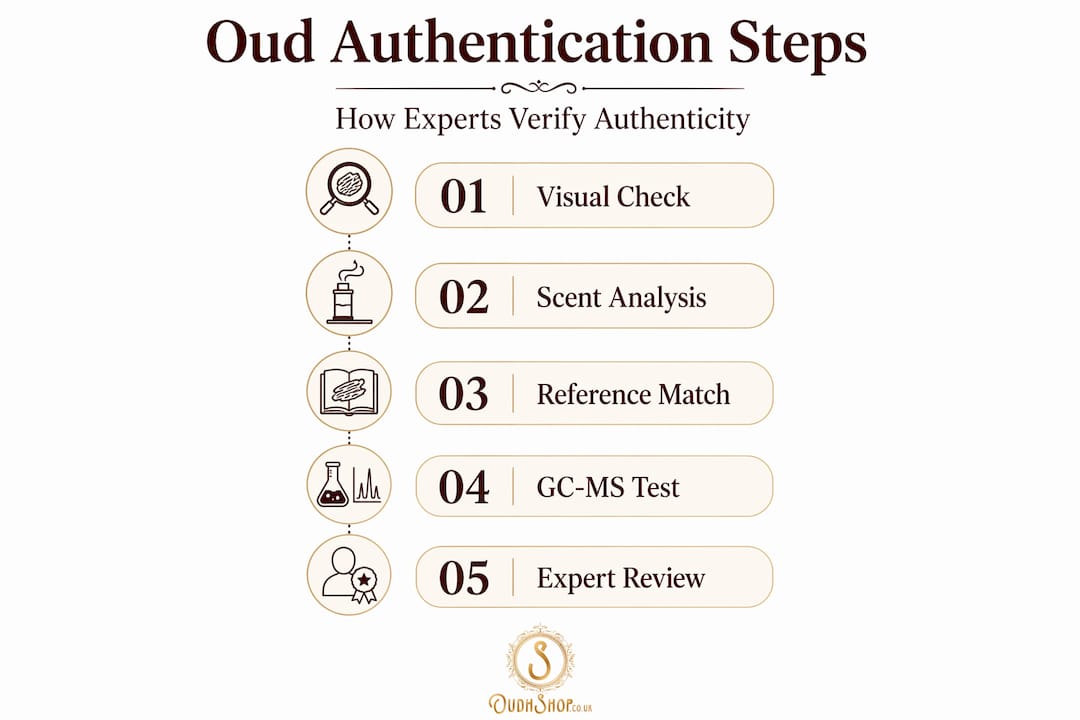
Even seasoned experts with decades of experience in Middle Eastern perfumery regularly commission GC-MS analysis when acquiring high-value oud oils. The nose is extraordinary, but chemistry does not lie.
Common pitfalls and mistakes to avoid
Even with guidance, enthusiasts sometimes make costly mistakes. Here’s how to avoid the most common ones on your oud journey.
The single most damaging assumption any enthusiast can make is that all genuine oud smells the same. As the fragrance community clearly states, oud’s profile varies widely across regions, species, and distillation methods, meaning your previous experience with one type of oud cannot be the yardstick for every subsequent purchase.
“Authentic oud is never ‘one size fits all.’ Every origin tells a different story, and true knowledge comes from patient, repeated exposure to a broad range of genuine oils.”
Trusting labels without independent verification is another frequent error. A label saying “pure oud oil” or “wild agarwood” carries no legal enforcement and is alarmingly easy to fabricate. Similarly, enthusiasts sometimes mistake an intensely powerful synthetic fragrance for genuine richness. Synthetic oud accords can smell impressive at first, but they lack the evolving complexity, the animalic depth, and the extraordinary longevity of the real thing.
Supplier reputation is not a nice-to-have; it is essential. Reviewing your oud fragrance selection process carefully before any purchase protects both your investment and your olfactory education.
Red flags to watch for before purchasing:
- No information provided about the country of origin or Aquilaria species.
- Price far below market rate for genuine oud oil (authentic oils rarely fall below a certain quality threshold without justification).
- Overly sweet or linear scent profile with no evolution over time.
- Unclear or generic labelling such as “oud fragrance oil” rather than “pure oud essential oil.”
- Lack of any traceability or certification documentation from the supplier.
- No customer reviews from verifiable purchasers with oud expertise.
Smart buyer checks:
- Request a certificate of authenticity or third-party test results.
- Purchase small quantities initially before committing to larger volumes.
- Cross-reference the supplier with established fragrance forums and community reviews.
- Compare the price against published market rates for the claimed origin and grade.
Why scientific analysis should complement tradition, not replace it
There is a temptation in modern perfumery to view laboratory analysis as the definitive arbiter of all things, reducing the extraordinary heritage of Middle Eastern perfumery to a list of compounds on a printout. We find this perspective both reductive and a little sad.
The cultural traditions surrounding oud span more than a thousand years. Perfumers, traders, and royalty in the Arabian Peninsula, South Asia, and East Asia developed extraordinarily refined sensory vocabularies for oud long before gas chromatography existed. These traditions encoded generations of knowledge about quality, origin, and character into the trained human nose. That knowledge is still valid, still valuable, and still beautiful.
The cultural allure of Middle Eastern perfumes is inseparable from the sensory tradition that shaped them. When you learn to identify authentic oud through your senses, you are not simply performing a quality check; you are participating in a living tradition that connects you to something far richer than a chemical data set.
That said, we believe science and tradition are not rivals. GC-MS analysis provides objective certainty that no human nose, however trained, can fully replicate. A masterful perfumer might correctly identify an adulterated oud in nine out of ten cases. Chemistry catches the tenth. Used together, sensory knowledge and scientific verification give you the most complete picture possible.
Anyone can develop a sophisticated nose with patience and consistent practice. Smell your reference samples regularly. Document your impressions. Seek out genuine oud from reputable sources. And when the investment warrants it, request a GC-MS report. The combination of these two approaches is not just the most reliable method for authenticating oud; it is the most rewarding path to truly understanding it.
Explore authentic oud with trusted experts
Ready to put this knowledge into practice? Exploring authentic oud should be an adventure, not a gamble, and we have built Oudh Shop precisely to make that journey as exhilarating and trustworthy as possible.
Browse our curated oud perfumes collection, where every fragrance is selected for genuine depth, exceptional quality, and authentic heritage. Not sure where to begin? Our intuitive perfume finder matches you with your ideal scent profile in moments, taking the guesswork out of your search. For those who wish to assess before committing, our range of perfume testers offers the perfect opportunity to experience the real thing before investing in a full bottle. At Oudh Shop, authenticity is not a promise; it is our standard.
Frequently asked questions
What does genuine oud smell like?
Genuine oud can smell earthy, woody, smoky, or even sweet, and its odour varies widely by region, species, and distillation, so there is truly no single correct scent.
Are there lab tests to confirm oud authenticity?
Yes, GC-MS and analytical methods are used to identify the unique chemical fingerprints of agarwood, making them the most reliable tools for objective verification.
Is price a reliable sign of authentic oud?
While authentic oud is generally expensive, a high price alone does not guarantee authenticity; always verify supplier reputation, request documentation, and cross-reference community reviews.
Can beginners reliably spot real oud by smell?
Beginners can absolutely train their noses over time with consistent practice and comparison, but combining sensory assessment with research and trusted sourcing yields the most reliable results.
What are marker compounds for real oud?
The primary marker compounds are sesquiterpenes and chromones, which are identified through GC-MS analysis in authentic agarwood essential oils and serve as the scientific basis for authentication.